
What does it really mean to let go?
Letting go means you stop clinging to the very thing that keeps you stuck. The SPH explains it with a simple trap used to catch birds in the forests near the Yamuna river in North India.
A small stick hangs on a thread between two trees. A bird comes and sits on one end. The stick turns, and now the bird is hanging upside down, gripping the stick.
The bird does not understand one thing. If it just lets go of the stick, it can fly. It already has wings. Nothing is holding it except its own grip.
Instead, the bird thinks, if I let go, I will fall, break my head and die. So it hangs there for two or three hours. Then the hunter comes, catches it and puts it in a cage.
This is the whole teaching in one picture. You are not trapped by the stick. You are trapped by your own holding.
The poor guy, he does not understand if he just lets go. The holding, the stick, he can fly.
Why is it so hard to let go?
It is hard because the mind keeps giving you one fear again and again: if I let go, I will fall and break my head.
The SPH says we are exactly like the bird. If you let go of your mind, you can just take off. He calls this becoming a Paramahamsa. But the mind does not want you to see that.
The fear can wear many faces. It may sound like, if I let go, what will I have or not have? Who will take care of me? These are different fears, but they come from the same place. Each one is the bird's voice saying, I will fall.
So the problem is not that letting go is dangerous. The problem is that the mind is sure it is dangerous, and it repeats this until you believe it. The fear is the mind talking. It is not the truth.
But your mind is again and again giving you the fear, what fear? If I let go, I may fall and break my head.
What actually happens when you let go?
Only one thing happens. You fly.
The SPH asks a simple question. Have you ever heard of a bird that let go of the stick, relaxed, fell, broke its head and died?
He says there is no such story. In the same way, he says there is no story of a man who left his mind, entered into consciousness, and then died in vain or became waste.
Then he gives the answer plainly. If you let go, only one thing will happen. You will fly.
If at all you let go, only one thing will happen, what that? He will fly.
What are we holding on to so tightly?
We are holding on to the body and mind, because we think they are our security.
The bird holds the stick because it believes the stick is keeping it safe. That is why it cannot relax. But the stick is the very thing that is trapping it.
The SPH makes the picture clear. The stick is the body and mind. You are the bird. Your soul is that bird.
There is a hard truth in the story too. The bird hangs on, thinking it is safe. Then the hunter comes and takes the bird off the stick anyway. What it thought was its security goes away, and its freedom goes with it.
In the same way, he says, we hang on to the mind. Yama is the hunter. Whatever we think is our security, body and mind, he will take that too.
So holding on does not keep anything safe. It only keeps you from flying while you still can.
The stick is the body, mind. You are the bird. Your soul is that bird.
Who can help you let go?
A bird that has already let go can help you. The SPH says this is the Guru.
Rarely, by good fortune, a bird that was hanging just like the others lets go and starts flying. That free bird then comes back to the ones still hanging. It pokes them and says: hey, relax. Let go. I was like you only. Relax. You can fly.
This is what the Guru does. He is not someone who never hung on the stick. He was there too. He knows the fear from the inside, and he knows the way out.
The SPH points out that not every hanging bird is lucky enough to have a liberated bird come to it. If one has come to you, that is a blessing.
What do you do when the free bird pokes you? He gives two words, and he repeats them: trust, let go.
some bird which was hanging like this, but it let go and started flying. The Paramahamsa will come and poke you. Hey, relax. Let go. I was like you only.
What should you do in the first moments after letting go?
Hold your courage for a few seconds. That short gap is part of the process.
The SPH shares an important detail. When the bird relaxes and lets go, it may take two or three seconds for it to turn and fly. In those seconds it is neither holding nor flying yet. It is just balancing.
So he asks for one thing: the courage to stay with those two or three seconds. The courage to balance yourself through them.
He gives this a name. Going through those two or three seconds of balancing is what he calls tapas.
Courage to have the two, three. Courage to balance yourself the two, three seconds. And go through the two, three seconds of balancing is what I call tapas.
How do I let go in daily life?
The SPH gives a very simple way to practise.
- When anything comes up in you, just say, ah. He says that as you do this, you will suddenly see the power of the mind over your inner space drop sharply.
- Even if you feel you are in a cage, do not bother.
He also describes what initiation does for you. Whatever you can do, you will do. Beyond what you can't do, you will relax. Whatever you can change, you will change. Whatever you can't change, you will accept. And you will have the intelligence to know which is which. He calls this the power of initiation.
Understand? Whatever you can change, you will change. Whatever you can't change, you will accept.
What stops us from letting go?
The mind's endless what-if questions stop us.
In the story, the free bird is right there, poking and saying, relax, let go. But the hanging bird keeps arguing. No, no, no. You don't know. If I relax, I may just fall. My head may crack. What will happen if I am an emotional bird?
The SPH says we do the same. We ask hypothetical questions and build bigger and bigger fears. He says we do this to defeat our own intelligence. He shows us that we can handle our problems, and the mind answers, no, you can't handle it.
He also notices that we sometimes ask the same fear in a new form. The question changes. The fear underneath stays the same.
This is why he feels real compassion for people. He says anybody who is caught by the mind twenty-four hours is in the worst prison. The questions feel like protection, but they are the prison walls.
The bird is hanging, he saying, no, no, no. You don't know if I relax. I may just fall, my head may crack.
What if I let go and I fall?
Even then, you are not alone. The SPH says there is a net below you.
He says he is not only telling you to relax and let go. He has also put a beautiful net below. Even if you fall, you can call on the divine grace, the divine presence. The net is there.
So look at the whole picture together. The bird has wings. The SPH says there is no story of a bird that let go and broke its head. A free bird is right beside you, poking and saying you can fly. And under all of it, there is a net.
The only thing left for you is the one thing the mind keeps resisting. As he puts it, all you need is let go.
The liberated bird is poking. All you need is let go. Let go and become Paramahamsa.
Watch the full satsang
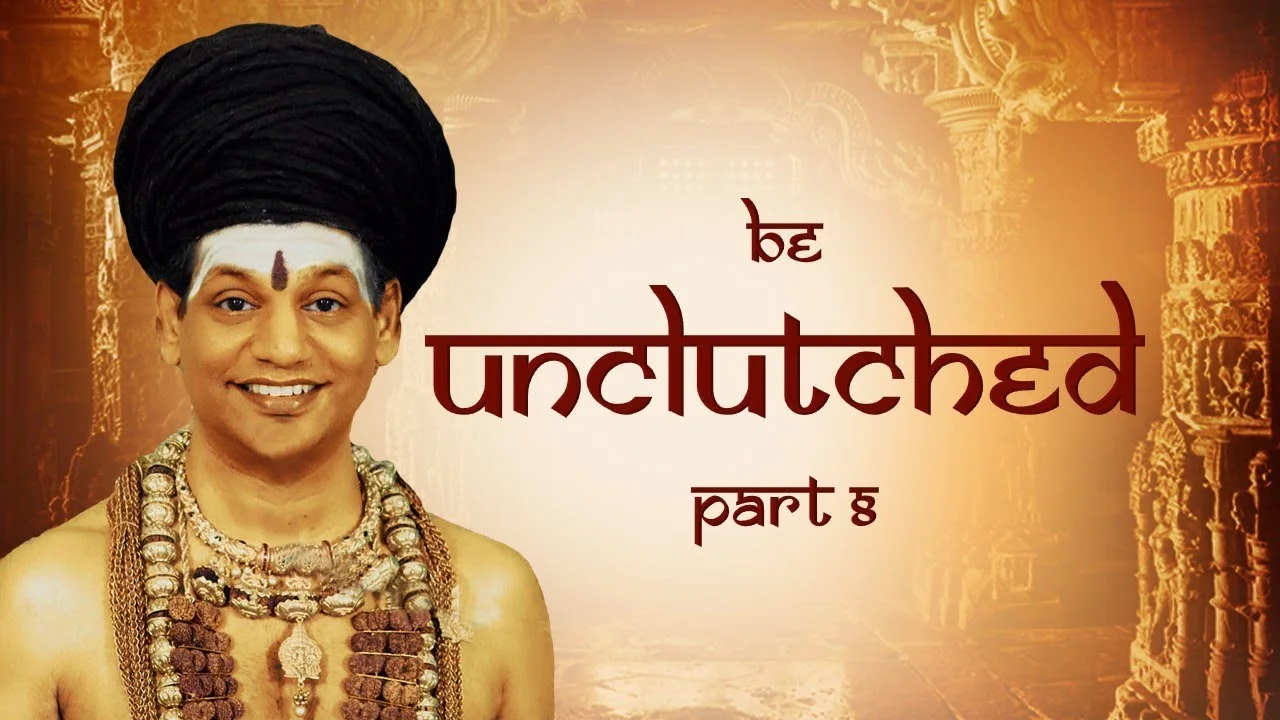
Be Unclutched (Part 8) | Nithyananda Spurana Program Session | January 7, 2008
Topics
Read similar articles

Why do I keep overthinking, and how do I stop worrying?
The SPH gives a simple definition: anything that goes on inside you, and that you are aware of, is worry. You keep overthinking because you fight that inner noise, and 99% of what you worry about never comes true, so the way out is to throw it out, not to argue with it.
What Is Fear, and How Do You Go Beyond It?
The SPH teaches that fear lives in the unconscious, the dark corners of the mind that you have never looked at. He says your very nature is beyond fear, and he guides a meditation in his program to go through the layers of fear.
What Is a Guru and What Does a Guru Really Do?
A guru is the one who gives you the best connection between your consciousness and your body. The SPH teaches that the guru puts the right powerful cognitions and mantras inside you, and that connection awakens powerfulness in you.