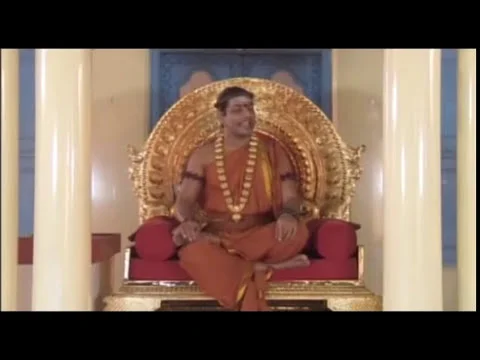
Feeling Connection the Ultimate Technique | Nithyananda Satsang | 13 May 2012
In today's morning satsang, Paramahamsa Nithyananda (Swamiji) continues his explanation of the founding philosophy of Madurai Adheenam. The young saint who established the present design of the math (spiritual community), Jnanasambandhar, makes no mention in his original writings of any of the schools of Hindu thought that later became predominant. He speaks only of his love for Devi and of Her uplifting infusion of energy, and of his desire to support and perpetuate the Vedic tradition. Vedanta, the philosophy which later grew to be associated with Vedic culture, was developed by Adi Shankaracharya, who lived several hundred years after Jnanasambandhar. Shankaracharya himself refers to Jnanasambandhar as a source of inspiration. The school of Saiva Siddhanta likewise evolved a t a far later date than the founding of Madurai Adheenam. Vedic tradition is the wellspring for both Vedanta and Saiva Siddhanta. Paramahamsa also gives a radiant description of Meenakshi, the embodiment of Devi who ruled Madurai. She encompassed the fullness of both masculine and feminine consciousness, being an equally great administrator and master healer. Her five-story palace adjoined a great hospital where students and teachers from many cultures worked together, caring for thousands of people who flocked from all over the world. Meenakshi was the epitome of wisdom, beauty, courage, compassion and efficiency, completely radiating divinity on Earth. TRANSCRIPTIONS:- As I introduced yesterday, Madurai Aadheenam is older than Vedanta and Siddhanta. Madurai Aadheenam is the source of Vedanta and Siddhanta. Sankaracharya does not speak about any Master in any of his verses, other than Jnanasambhandar. Other than Thiru Jnana Sambhandar, he does not praise anybody; especially when he is praising 'Mother', when he is singing the glory of 'Mother' in Soundarya Lahari. Soundarya Lahari is the stotra describing Devi, describing Divine Mother, the Cosmic Mother, 'Padadikesha' means from foot to head. He is describing Devi, praising Devi in Soundarya Lahari. At that time when he is describing the breasts of the 'Mother', he is saying, 'the breasts which has created Jnana Sambhandar by giving the milk'. He is attributing Jnana Sambhandar as one of the glory to 'Mother' Herself. It means, he was inspired, impressed, influenced by Thiru Jnana Sambhandar. Vedanta philosophy originated from Adi Sankaracharya and Adi Sankaracharya was highly inspired by Thiru Jnana Sambhandar. Whatever I am giving, everything is a historical fact. Please understand, everything is a historical fact. I am not talking the mystical facts. I am not talking some mystical subject, I am talking fact and of course, Saiva Siddhanta directly acknowledges Thiru Jnana Sambhandar as the first, foremost of the whole Saiva philosophy. So, all the philosophies whether it is Vedanta or Siddhanta, evolved from Thiru Jnana Sambhandar. Two days before in the satsang, I was making one statement about Chokkanathar; Sundareshwara, the divine expressing in human biomemory, very down to earth. Today, I wanted to make remaining three more statements. That day I said I wanted to make four statements, one about Chokkanathar, one about Meenakshi, one about Thiru Jnana Sambhandar. I already made the statement about Chokkanathar, now I wanted to describe Meenakshi. All the grandeur of masculineness and the beauty of feminineness expressed in one body that is Meenakshi. Please understand, if I have to define, describe Meenakshi in one line, of course, it is impossible, but if it is forced, this is the description I will give: All the grandeur of the super consciousness, the masculine principle and the beauty of the feminine consciousness, the divine feminine principle expressing in one body is Menakshi. Meenakshi shines more than Chokkanathar. Meenakshi radiates more than Chokkanathar. I was thinking I should not tell these words, but truth can't be hidden, somehow it comes out. Meenakshi, I started describing her history only, but it was so much!, Now, really I feel, I put myself in a big mess of trying to describe which can never be described. See, I can describe maybe one or two incidents from Meenakshi's life, one or two incidents from Chokkanathar's life, one or two incidents from Jnana Sambhandar's life, but I cannot the describe the 'whole' as it is!! But I have decided and have given a topic, 'The complete History and Philosophy of Madurai Aadhenam', where I have to describe everything amidst so much that is happening around me. It is not that I am in a peaceful ambience and atmosphere like Bidadi, where I can go on sit and explain, explain, and explain. Here, all around there is fire, continuously I am fire fighting. So many, astras are being sent towards me: Nagasthra, Bramhastra, Varunastra, Vayusastra, Agniastra. Of course, I am just turning all that back and sending them back to them; same persons! One side, this fire fighting, the other side I have to explain the glory......