
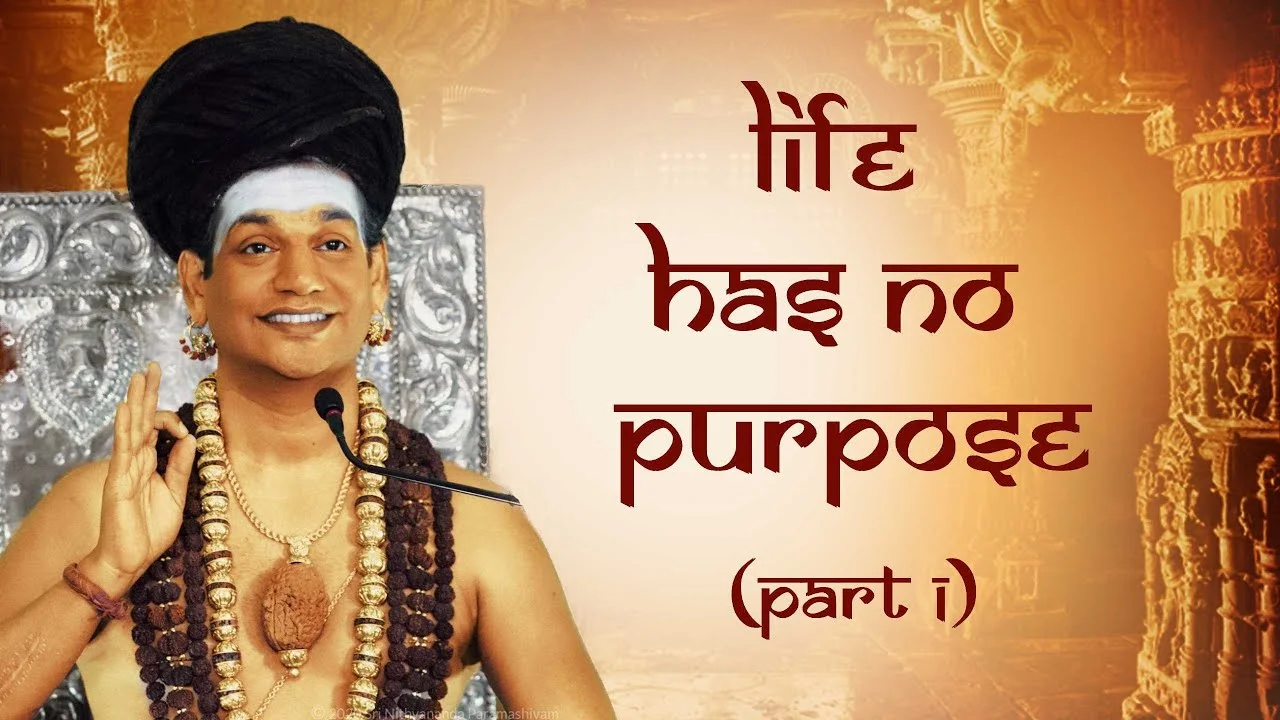
What does The SPH say about how to find your purpose in life?
The SPH gives a surprising answer. Life itself has no purpose. The whole existence, the whole drama, is purposeless.
He admits this is very hard to digest. Most of us built our whole sense of self on the belief that life has a purpose. For some it is money. For some it is relationships or knowledge. Some people drop all of these and pick up a new purpose: enlightenment. But it is still a purpose they run after.
The SPH says that whatever is taught to you as purpose was taught to you by society. It did not come from life itself.
So the search for a purpose is not the way out. The way out is to see, clearly and maturely, that there is nothing to chase. The moment you understand that the whole life is purposeless, something shifts. You do not go behind enlightenment. It simply happens to you.
This is not a sad or empty idea. As the rest of the teaching shows, it is the door to living fully.
The whole existence, the whole thing is just purposeless, but very difficult to digest.
Why does chasing a purpose make the ego stronger?
In this satsang, The SPH links purpose and ego very directly. The more purposes you create, the stronger your ego becomes.
Someone once asked him, what is ego? His answer was simple. If you think there is some purpose in life, that is your ego. That is where the ego is stuck.
Think about how we talk. My daughter has to get married. I have to settle my responsibilities first. Once this is done, then I will relax. Each of these is a purpose, and each one gives the ego something to hold on to.
This is why spiritual goals do not escape the trap either. If you swap money for enlightenment and run just as hard, the ego is still in charge. Only the name of the goal has changed.
The SPH says enlightenment is nothing but living without ego. So the ego disappears the moment you truly understand the purposelessness of life.
The more you think your purpose, more your ego will become strong. The more purposes you create, more your ego will become strong.
If life has no purpose, what is the meaning of life?
Purpose and meaning are not the same thing here. Life has no purpose, but it does have a meaning. The SPH says the meaning of life is bliss.
The key is the order. First you understand that the whole thing is purposeless. Then you start realizing the meaning of life. As long as you hold on to a goal, you miss the path. When you drop the end purpose, the meaning shows itself.
Bliss cannot be grabbed as a new goal. The SPH says bliss by itself is choiceless. When you are choiceless, bliss happens to you. The moment you make bliss your choice, your target, it starts to disappear.
He uses the image of a river. Put your hand in the river and the water flows through your hand. Try to hold the river, and you are left with an empty hand. You have to let it happen. You have to let it flow.
So you do not find meaning by hunting for it. You find it by letting go of the hunt.
The moment you understand, the whole thing is purposeless, you start realizing the meaning of life. The meaning of life is bliss.
What does the bubble story teach about purpose?
The SPH tells a story about water bubbles on the ocean. So many bubbles appear and vanish, like soap bubbles. Our life, he says, is almost the same.
Picture one bubble that gathers four or five bubbles around it. You are my wife, stand here. You are my husband, stand here. You are my daughter, you are my mother, stand around me as protection. Then it collects one or two grains of sand from the beach, calls them its treasure, and locks them inside. Now it feels safe and secure.
But the bubble does not understand. In the next two seconds, not only that bubble but its whole family will disappear.
The story goes one step further. One big bubble says, I am going to become enlightened. It renounces all the other bubbles and goes off for tapasya. And The SPH asks, what's the purpose?
His point is that everything we call great, whether wealth, relationships, morality or even spirituality, sits inside this same drama. You cannot carry any of it with you. Not even a single checkbook.
Same way, in the eternal life, we are all bubbles, just we happen and disappear.
What is the only real mistake you can make in life?
The SPH says that if there is anything called sin in life, there is only one. It is missing the life.
Missing the life means always thinking about the goal. You are so busy looking at what comes next that you never live what is here. The goal keeps you running, and the living passes by unseen.
People often tell him, once I settle my social responsibilities, I will come and be with you. They put real living off until the goal is done. This is exactly how life gets missed.
His instruction is simple. When you live, let your very living be blissful. Not after the goal. Not when the responsibilities are over. Now, in the living itself.
This turns the usual question upside down. Instead of asking what your purpose is, you can ask whether you are actually living, or only running toward something.
Missing the life, thinking the goal, continuously thinking the goal and missing the life is the only sin.
How can you stop running after a purpose in daily life?
The SPH says the whole gist of his teaching fits in one line: do not allow continuous uneasiness or restlessness inside you. That is enough.
He explains that purpose and uneasiness are one and the same. The constant irritation you carry is there because you are running behind a purpose. It is there because you do not relax into the present moment.
He gives a few simple things to do:
- When you are hurrying early in the morning, relax for a few seconds and ask, what for am I hurrying?
- Whenever restlessness or irritation comes up, sit for two or three minutes.
- In those minutes, think about what you are running for and what you believe is your purpose.
- Look at it honestly. Big house, big car, many relationships, people who praise you. Can you carry any of it with you?
The SPH says that when you analyze like this, you suddenly understand the whole thing is purposeless. That understanding is what lets you relax into the present moment.
Do not allow continuous uneasiness or restlessness inside you. That is enough.
Why doesn't reaching a goal bring the rest you hoped for?
Most of us believe we will relax once one more thing is done. The SPH says to be very clear about this. By the time you reach that goal, ten goals will be waiting.
He describes how it goes. After college, I will relax. No, when I get married. After marriage, when I have kids. After the kids, let them finish college. After college, let them get married, then my responsibility is over. And he asks, after that, have you seen anybody relaxing?
Even if you do not create ten new goals, something else has happened. Running and not relaxing have become part of your conditioning. By the age of sixty, the habit is set.
This is why some people feel lonely when their responsibilities finally end. They cannot sit with themselves. They lived with uneasiness for so long that without it, they feel they are missing something.
The lesson is not to wait. The restlessness you allow today becomes part of your being tomorrow.
Be very clear. By the time you reach that goal, ten goals will be waiting.
How does measuring life by money block you?
Another thing that keeps us from seeing clearly is how we measure our lives. The SPH points out that we often reduce our whole life into dollars.
How do you measure one month? By your salary. One month I make this much. Twelve months, this much. In five years, this much. That becomes the value of your time.
Then he asks a sharp question. Suppose someone offers you a hundred years of salary in one paycheck, but you have to die. Would you give your life? Of course not. Yet he says we are doing just that, maybe not directly or fully, but slowly, slowly.
The moment you start measuring your life by your paycheck, you reduce the spirit into matter.
He also notes that the mind always waits for something to happen. Seeing this habit is part of dropping the false purpose and coming back to life as it is now.
May not be fully, but slowly, slowly, the moment you start measuring your life by your paycheck, by your dollars, by your salary, you reduce the spirit into matter.
Watch the full satsang
Life has no Purpose (Part 1) | Ananda Spurana Program Session | October 16, 2005
Topics
Read similar articles
What Is Abundance? Being Alive, Active and Contributing
Abundance is not how much you own. The SPH says abundance is how much time you are alive, active and contributing, and how many things you are passionately involved in, so true wealth should make you more active and more responsible, not lazy.
What Is Moksha, and How Do You Live a Moksha-Centred Life?
Moksha is deciding that you are Paramashiva, the ultimate truth, and living from that space. The SPH says this decision itself is moksha and samadhi, and that from it you can do your work, enjoy life and fulfil your duties.
What Is Fear, and How Do You Go Beyond It?
The SPH teaches that fear lives in the unconscious, the dark corners of the mind that you have never looked at. He says your very nature is beyond fear, and he guides a meditation in his program to go through the layers of fear.