
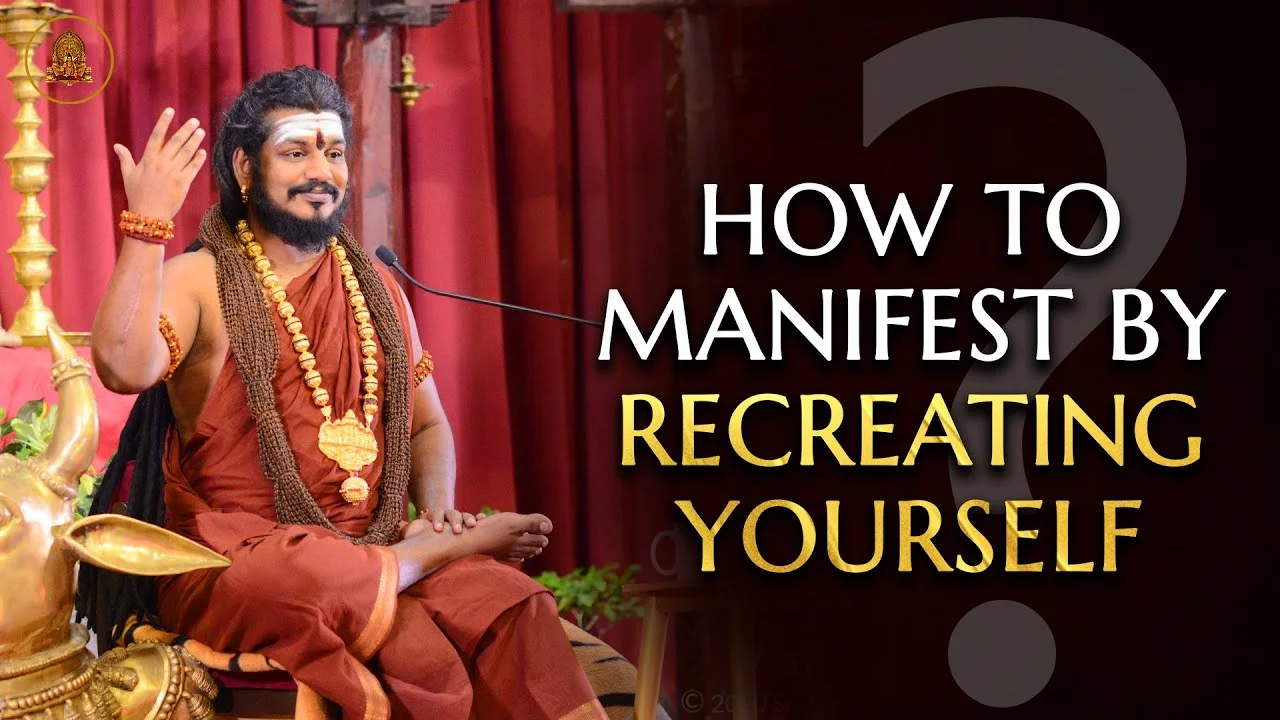
Are you a finished product, or a seed that can still grow?
You can still grow and change, The SPH says. A human being is a great possibility, carrying a seed. You are not a finished product. You can reorganize, redo, and reinvent yourself as you want. What you have become so far does not settle what you can become next.
A seed has not sprouted yet. A plant has not grown its branches or brought forth its leaves. The seed needs to open. Sprouting needs to happen. The plant needs to grow and flower, the branches need to grow, and the leaves need to come. He uses those stages to describe a life that still has more to unfold. Calling yourself complete would leave no room for the growth he describes.
Even Sadashiva, he says, constantly considers himself a seed that is "yet to manifest." Even after manifesting the whole world, he still comes down to make people manifest powers and push them to the next level.
The good news is, you can always manifest, reorganize, redo, reinvent yourself as you want.
Why does saying this is the way I am stop you?
It treats your current patterns as final, The SPH says. He describes people who tell him, "I have so many patterns, I wanted to break, but this is the way I am." They speak of wanting change, then close with a statement that rules it out.
His reply challenges the last part of that sentence. You are not simply the way you think you are, he says. A person may see patterns they want to break without having to accept those patterns as the end of who they can be. He calls the fixed stance ego: "this is the way I am, what can I do?"
Another objection appears later: "Oh, I am already old and tired. How can anything more happen to me? How can anything new happen to me? Where is the new life?" Here, the person has decided that the chance for something new is gone. The questions all point toward the same closed answer.
He responds that the moment you decide there is no new life for you, there is no new life. Then he makes the opposite claim: every situation brings new life. In his teaching, even the situation a person calls final can bring an opening. Saying nothing new can happen shuts out that opening before it arrives.
the moment you think, this is the way I am, what can I do? You have become egoistic.
Is imagining the life you want enough to manifest it?
No, The SPH says. Fantasizing about change and working for it are different. When someone says they wanted to break their patterns, his reply is direct: "You fantasized about breaking, never wanted to break." He challenges whether the wish has become something they act on.
He describes the appeal of becoming a new being. You see the way others radiate and have an idea of how it would feel: "butterfly in the stomach, rose in the heart, light in the eyes." The imagined change is vivid. It has a feeling and an image you want to experience for yourself. Yet in the situation he describes, the person has never worked or acted for it.
He makes the same distinction with completion: "Fantasizing about completion and doing completion is totally different." Enjoying the idea of being changed does not amount to doing what you imagined. His challenge is aimed at the gap between the fantasy and the work.
"Action manifests Shaktis," he says, referring to powers. He follows it with a direction: acting toward what you want. His answer to how to manifest includes that action, beyond the wish to feel like a new being. The work is toward the change you want to bring about.
action manifests Shaktis. Acting towards what you want manifests Shaktis.
What happens when the change you wished for arrives?
You may still want to hold on to the old life, The SPH says. He describes someone who wins a billion dollars in a lottery. A palatial bungalow is ready. They had wanted that home and waited for it. Now they can move in, yet they start crying over the small house they are leaving.
"The small house has been snatched away from me" is how he describes their reaction. The bungalow is there, but the person is caught up in losing the old home. They wanted the move while it lay ahead. At the moment it becomes possible, they want to keep what they already had.
He says he has seen people cry when the great transformation they were waiting for happens. What they prayed for arrives, and suddenly they are not okay with the opening. They reach back toward the old.
He calls this "tasting the old" and "tasting the boredom." Even boredom is something a person can keep holding on to. He names that taste for anti-life the biggest enemy in life and urges people to break it.
I have seen people crying when the great transformation happens to them for which they were waiting.
Where do time and energy fit into manifestation?
Put your time and energy toward what you want to manifest, The SPH says. He speaks of great possibilities ahead of us, then calls for two things: open up, and put time and energy toward them. Seeing a possibility is followed by giving something to it.
"For anything if you put your time and energy, that will become reality," he says. He applies that statement directly to manifestation. His emphasis is on where your time and energy go. The reality you want to bring forth is what he asks you to put them toward.
"You can always redesign and develop the life you wanted," he says next. You can always bring that life forth, he says, and awaken yourself to the reality you wanted.
If you put your time and energy for your manifestation, that will become reality. What for you put your time and energy, that will become reality.
What do anava, karma, and maya mean here?
The SPH uses three terms to describe feeling bound. Anava means considering yourself bound by patterns and impossibilities. Karma means what you think binds you. Maya means thinking you do not know what to do to get out.
He keeps the wording close to what a person thinks: "considering yourself as bound" and "what you think binds you." When he speaks of not knowing a way out, he again says "if you think." He is describing the person's view of their limits, including the belief that they cannot find a way beyond them.
He does not leave the person at the point of naming what binds them. After describing the patterns and the uncertainty, he turns to the will to break them.
considering yourself as person bound with patterns and impossibilities is ānava.
What do you need to rebuild your life?
You need will, The SPH says. He repeats the call: "Will, will, will, will to break it." He speaks of redesigning life. The will he calls for is directed at what you consider your patterns. He keeps returning to breaking through those patterns, rather than accepting them as the life you must keep.
Near the end, he gives four points as the essence of the satsang:
- You are not a complete product. You are a seed.
- You can break through the things in which you are stuck.
- You can rebuild your life newly and manifest what you want.
- All you need is your will.
His final image is of strength rather than drifting. He asks people not to be like floating dead straw, but to stand with the strength and willpower of Sadashiva's trishul, the trident.
Even that trishul, he says, is a dead bamboo. Because a person with will holds it, it becomes the trishul. The bamboo alone is not what gives the image its strength; the person holding it brings will.
Even Sadāshiva's Trishul is just one dead bamboo, but because it is held by the person with will, it becomes Trishul.
Watch the full satsang
The Real Law of Attraction | Recreate Yourself & Manifest Any Reality You Want
Topics
Read similar articles

Is life predestined, or do we have free will?
The SPH says life is not only predestined and not only free will, and God's will alone does not explain it either. His answer is super-determinism: you, God and the natural law of the universe are one at the core, and you manifest your life from that understanding.
What is karma, and what makes karma good or bad?
The SPH says karma is not about how big or how good an action is. The cosmos records only violence: the pain you cause by breaking the principle "let us all coexist." Good karma is the celebration you add; bad karma is the pain you cause.
What is victim mentality, and how do you let go of it?
The SPH describes victim mentality as holding on to the idea that you have been wronged. He calls letting go of pain and its justifications tyaga, and asks you to see your past from more than one angle.