
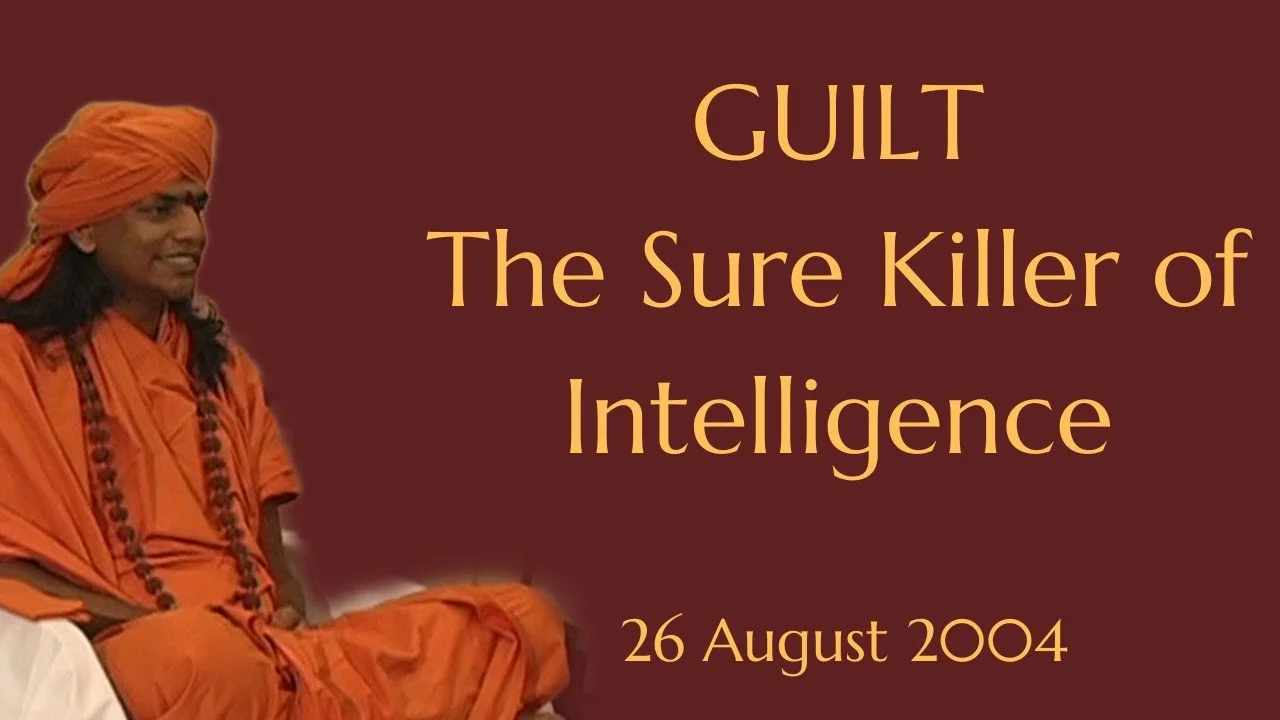
Why is guilt called the killer of intelligence?
Guilt stops you moving in life, The SPH says. Understanding brings intelligence; reduced to superstitious belief, that same understanding creates guilt.
Understanding is nectar for your life. It brings tremendous intelligence. But you can reduce that understanding to a belief. Deep guilt follows the change, and what once gave you intelligence holds you still.
The SPH calls guilt the worst killer of intelligence and asks you to break free of it. Right listening and right understanding can let your innate nature express itself. Understanding can do that work.
Intelligence is existence, in The SPH's words. His call to let go of guilt reaches that far. Freedom from guilt opens the way to experiencing intelligence and eternal bliss.
According to me, guilt is the worst killer of intelligence. Guilt will never let you move in your life.
What are the three kinds of guilt, and how do you spot them in your own life?
The SPH names three sources of guilt: your immediate family, social laws, and yourself. The third grows when you take in the greed and fear behind the others.
Family comes first. Your father, mother, and immediate family can create this guilt. The SPH links both guilt about sex and guilt based on greed to this layer.
Social laws form the second layer. Here the link is fear.
Self-created guilt is the third. You take in greed and fear, then create a new kind of guilt for yourself. The SPH calls this the worst kind. What began with family or social laws has become something you create within yourself.
To spot these layers, use The SPH's test: look wherever you have fear, cannot move, or cannot make a decision. Examine the point where you feel stuck. Does the guilt come from your family? From social laws? Or have you taken in greed and fear and created more guilt yourself?
And the third guilt is the worst guilt, which you create for yourself. When you internalize the greed and the fear guilt, you create new type of guilt for yourself.
Can you be a good person without guilt?
Yes. The SPH puts understanding and consciousness at the root of morality; guilt-based morality is only skin deep.
The SPH asks a plain question: what would you do if there were no punishment? If fear of punishment is the only thing holding you back, he calls that immaturity. Rules were created for our own sake, and you can understand that. Losing the fear of punishment need not turn you into someone who hurts others.
The SPH asks you to understand why rules exist. If your conduct depends entirely on punishment, it rests on the threat. Understanding gives your conduct another basis. You can act from that understanding without needing guilt to keep you in line.
Consciousness is the word The SPH chooses, and he distinguishes it from conscience. Do's and don'ts can become a buffer between you and enlightenment. Depending on them alone leaves you in the position of a child.
A buffer stands in the way. As long as it remains, you cannot reach the freedom, bliss, and ecstasy The SPH calls enlightenment. Once it goes, enlightenment can reach you.
Let your morality be based on understanding. Let your morality be based on consciousness, not on conscience.
How do you let go of guilt?
Let go of the past by understanding and accepting what is, The SPH says. The past is dead weight: it is gone, yet you keep carrying it.
The past is dead. Guilt keeps it as a weight on your being. The SPH asks you to break free of that weight so you can proceed in life.
Watch the two directions your attention takes. You work or worry about the past. Or you work or worry about the future. Something keeps going on. The SPH traces that movement to not understanding and accepting what is.
Your craving can point outward, toward something you want to achieve in the world. It can also point inward. Even a craving for enlightenment can send you toward the future. Wanting to achieve something inside still means reaching toward something ahead of you.
The change he asks for begins with what is already here. Understand and accept your reality. The past keeps its weight, and the future keeps its pull, while you remain caught between them. Acceptance lets you step out of that rut.
See, you are pulled towards the past or towards the future, because you don't understand and accept what is.
What if you cannot accept what happened?
You can begin by accepting that you cannot accept, The SPH says. Full acceptance is not a condition you must meet first.
If you cannot accept your reality completely, that limit is part of your reality too. This applies to your inner world and your outer world. You may find it hard to accept either. The SPH makes room for that exact difficulty.
Even the push and pull you feel can be accepted as what is happening. You do not have to claim you can accept one hundred percent. Start with the fact that you cannot. The SPH calls that much acceptance enough.
Sincerity gets the same treatment. If you cannot be sincere, accept even that. The SPH calls that much sincerity enough. The instruction reaches right down to your difficulty following it. You can acknowledge the place you are actually in, including the fact that you cannot yet do what is being asked.
If you can't accept, then at least accept that you are not able to accept.
Do you have to fix yourself before you can be free?
No, The SPH says: keep living with understanding. You do not have to suppress greed or fear before you can express enlightenment.
A listener asks how enlightenment can be practical without a long search or techniques. The SPH answers with understanding itself.
Everyday life is housekeeping in the dreams, as The SPH puts it. You still do the housekeeping. You understand what you are doing, so it does not disturb you so much. Continue the same work with that understanding.
The SPH calls enlightenment eternal bliss that events in the outer world cannot disturb. The outer world is the outer world; the inner world is the inner world. You can keep doing things outside while letting that understanding sink in.
Toys make the point concrete. You once played with them, then put them aside. Do you stop giving toys to children because you have outgrown them? Of course not. You let a child play until maturity comes. The SPH gives you the same room to keep playing while understanding develops.
Let this understanding sink in as you do the work. The SPH calls continuing with clear understanding enough to express enlightenment. You can keep doing the housekeeping because you enjoy it.
Continue to do the same housekeeping with this clear understanding. It is more than enough to express your enlightenment.
How do you try the three-day acceptance experiment?
Try three days of accepting your inner and outer world. For that short trial, The SPH asks you to stop trying to change other people, circumstances, or your personality.
For those three days, relax your concerns about both worlds. The SPH asks you to live satisfied for that short stretch and see what happens.
Follow these instructions for the experiment:
- Leave other people and the outer world as they are. Do not try to alter them.
- Do not try to alter your inner personality. The trial includes what happens inside you.
- Do not try to become less angry or less fearful.
- Accept what is happening, including any difficulty with acceptance.
- Give this a sincere trial for three days.
Will you lose anything in those three days? The SPH says no.
You may have spent years living by your own ideas. The SPH asks for a short trial of this one. Give those three days to the experiment and find out what the experience is like.
The aim is a glimpse of living in the present moment. The SPH describes a different space opening through the trial.
Don't try to become less fearful. Don't try anything. Only one thing, accept. Just for three days.
Why does living in the present moment help?
Living in the present lets you meet what The SPH calls eternity. Time is a shaft you can penetrate only in the present moment.
Picture that shaft. While you remain below it, it rules you. When your consciousness rises to the present moment, you penetrate it. The SPH describes a reversal: the thing that ruled you becomes your servant.
Eternity enters time at that point. The SPH places intelligence and intuition there too. You miss them when you never fall into the present moment. Being here lets you experience what he says you have been missing.
Hours can disappear when you are with someone you love. The SPH contrasts a clock's equal seconds with the gap between thoughts. That gap differs from person to person and grows with bliss. In the present moment, that gap grows, and you no longer notice time passing.
The SPH describes a tremendous realization when you penetrate the shaft: past and future become clear, and you see time as your own projection. Eternity is the name he gives this different space. You enter it in the present moment.
If guilt feels too heavy to carry alone, talk to someone you trust or a qualified counsellor.
The eternity penetrates the time shaft only in the present moment.
Watch the full satsang
How to Deal with Guilt and Shame
Topics
Read similar articles
What Is Dharma? Living in Tune With How the Cosmos Works
Dharma means knowing how the cosmos works and aligning your life to it. When your wealth and your pleasures are both centered on dharma, life flows naturally toward moksha, complete freedom.
Is life predestined, or do we have free will?
The SPH says life is not only predestined and not only free will, and God's will alone does not explain it either. His answer is super-determinism: you, God and the natural law of the universe are one at the core, and you manifest your life from that understanding.
How do you manifest the life you want?
The SPH teaches that learning how to manifest begins with seeing yourself as a seed, able to grow and change. Act toward the life you want, put time and energy into it, and bring your will to breaking the patterns you consider binding.