
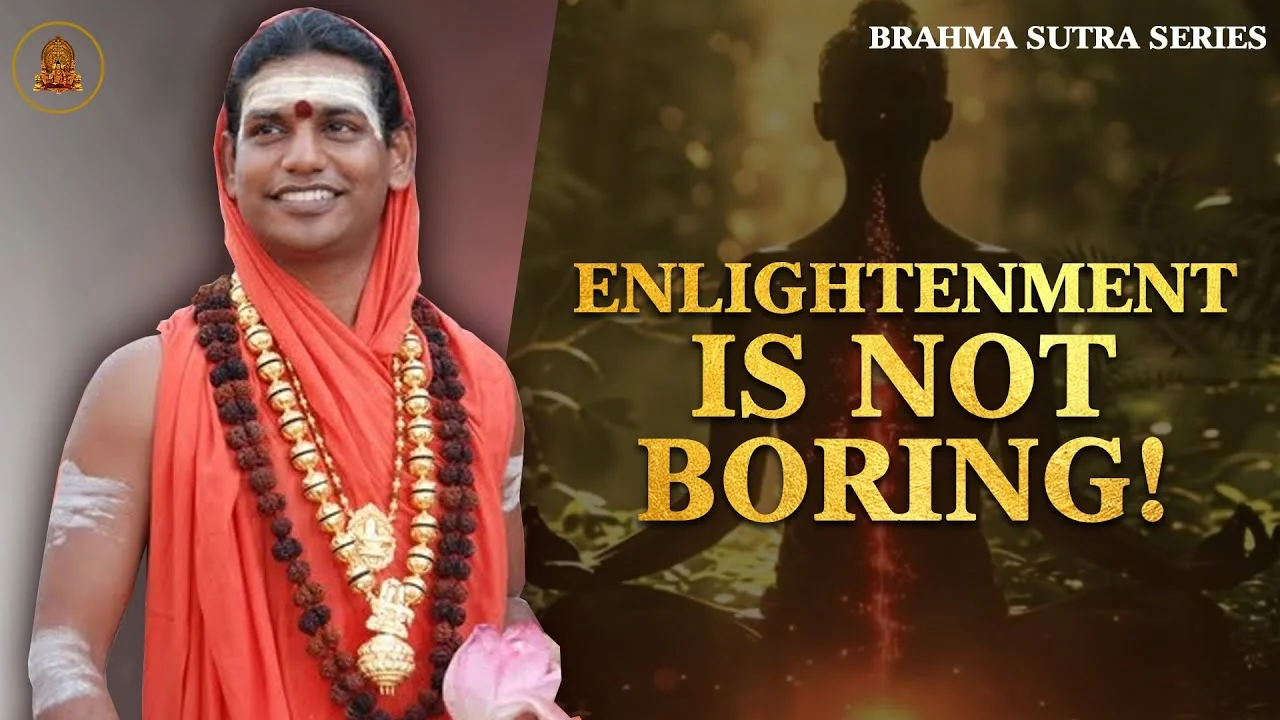
How can I increase my intelligence?
The SPH starts from a surprising place. You do not build intelligence from nothing. You are already made of it.
In this satsang on the Brahma Sutras, he explains one sutra in a single line: the cause of everything is intelligence. And if the cause is intelligence, the effect has to be intelligence too. You are the effect. So intelligence is not something far away that you must collect. It is your very source.
What changes is whether you realize this. The teaching puts it as a clear choice. If you have not realized that your cause is intelligence, then in your own life your cause is dullness. You can take either stand. But whichever stand you take, you will go on living from it.
So the first step is simple. Take the stand that your source is intelligence. Then the work is to make that truth so clear that you think, feel and decide from it every day. The rest of this article is about how to do that, in the way the satsang lays it out.
If cause is intelligence, effect also has to be intelligence.
Why does the effect have to be as intelligent as the cause?
The SPH uses the example of gold. If you could mix copper into gold, anything made from it would be lower quality. But in this example, nothing can be added to the gold. It is pure. So anything made out of that gold is also pure.
The cause of existence is like that gold. The satsang calls it nirmala and niranjana, which he explains as pure, unable to be polluted or mixed with anything. If nothing can be added to the cause, the effect must be an exact version of the cause.
This leads to a bold line: anything you think is not intelligence does not exist. How can the effect be different from the cause? It is impossible.
The trouble is the mind. It keeps saying, no, the effect has some impurity. But Badarayana says no. Cause is intelligence.
But the copper cannot be added at all into the gold. Nothing can be added to the gold. It is pure.
Why doesn't hearing a deep truth once make me smarter?
The SPH describes what often happens. You hear something powerful. Half an hour later you go to dinner on your usual routine, and it is over.
He says hearing it once in that way cannot lead you to enlightenment. That is why he repeats the same truth again and again in so many forms: cause is intelligence, cause is Brahman, cause is truth, cause is source, cause is compassion.
The goal of repeating is clear. A truth has to be told again and again until it becomes part of your life. Until it becomes the understanding your decisions come from, even in your dreams.
He explains that the understandings you use to make decisions in a dream are your real essence. They are the base from which you see your daily life. So the test of a truth is not whether you agree with it. It is whether it has reached that deep.
It is like any concept shared, your brain opens to that idea for 10 minutes and it closes again. By the time you go to the dinner, it is over.
How does debate help an idea sink in?
The SPH's answer is debate. Your ego will grab an idea only when you debate it. When you stand up for an idea in front of others, your ego attaches itself to that idea. If the other person is not convinced, you fight for it. If they are convinced, you become convinced too, because you were able to convince them.
He gives a lovely image. Your ego is a ball of clay. The truth he gives you is a diamond, just resting on top of the clay. Debate is like hitting that ball again and again with another stone. The diamond sinks deeper into the clay. As you keep hitting, the clay falls away. In the end, only the diamond is left in your hand.
The satsang lists three gains from debate:
- You understand the idea better from other people's views.
- Many of your smaller understandings get cleaned away.
- When you stand for an idea, you start living that idea, even without knowing it.
Debate feeds the ego, he admits. But he uses that very activity to remove the root of the ego. You take the side of a spiritual truth, and without your knowing, that truth swallows you.
The diamond will be in your hand and the clay will leave your hand. This is the exact process of debate.
What are the rules for a debate that grows your understanding?
The SPH gives a simple format. It is about analyzing. Debate does not mean you have to fight, and it does not mean you have to accept the other person's idea.
The three rules from the satsang:
- Your body temperature should not rise. That means no anger and no violence.
- Talk only from the ideas you actually make your decisions on every day, or the ideas you are going to make decisions on from today.
- You do not need to agree or disagree. You can agree, you can disagree, or you can say you are interested in neither and want to dig deeper.
The second rule is the heart of it. Honesty keeps the debate real. If you claim an idea, you live by it.
He compares this sutra to a master key. It can open some two thousand doors, the problems of your life. He cannot cut a separate key for each of your doors. You have to take the key and open them yourself. Debate is how you turn that key.
Your body temperature should not increase, means no anger or violence.
How do listening, clarity and action build real intelligence?
The SPH describes three stages. Together, they turn a truth from words into something that works in your life.
- Shravana: listening to the truth.
- Manana: taking it in and arriving at clarity.
- Nididhyasana: expressing from that clarity, so that the functionality evolves.
He sums it up in three short phrases: listening, imbibing clarity, evolving functionality. That is the whole essence.
In this satsang, he gives the listening part himself. The seed is the line, cause is intelligence. Your part is the next step. You debate this truth and come to clarity. Then, with deep clarity, the functionality will arise.
He says Vedanta should become vyavaharika, which he explains as practical, day to day. These truths should become applied science in your life. That happens through debate. Debate gives deep clarity, and from deep clarity, the practical ability arises.
So if you want more intelligence in how you live, do not stop at listening. Sit with one truth. Argue it out honestly. Let clarity come. Then act from it.
Listening, imbibing clarity, evolving functionality.
What is higher cognition, and how can I stay in it?
The SPH introduces a new phrase here: higher cognition. It means taking in life based on a higher understanding.
His example is a sacred feeling for the guru. You notice that the ideas you receive are raising you so much. Then you wonder what state the one giving them must be in, and a strong love arises. That way of seeing, born from higher understanding, is what he calls higher cognition.
The more higher cognitions you take, the more time you stay in that higher space. He calls this the real wealth you are building. Every action, thought and feeling that comes from higher understanding adds to it.
So he gives you a simple question to ask yourself each day: how much time did I spend in higher cognition today?
And he tells you what helps. Debate keeps you in higher cognition continuously. Each idea that goes deeper and deeper into your system forms the base for your higher consciousness.
Every action out of higher understanding, every thought out of higher understanding, every feeling out of higher cognition is a wealth you are accumulating.
What stops my intelligence from growing?
The SPH names a very human habit: the respected dustbin. You hear a great idea and say, wonderful, great. But you also think, it is not practical, it is not for me. You will not throw it in a normal dustbin. That feels too rude. So you keep a respected one, which is never emptied and never used. Sometimes you even garland it and do arati to it. But you never pick up the ideas and use them.
The second block is old stands. He says the whole of life is taking certain sides and going on justifying them. People often take a stand without even knowing why, and defend it for their whole lives.
The way out uses the same habit. Now you can choose which stand to take: cause is intelligence, or cause is dullness. You can take the stand that you are not intelligent, not enlightened, and stay cozy with it for life. Or you can take the stand that your source is intelligence and live for it.
Whatever you choose, be honest. Define it in clear words, with no grey area. Then make your decisions from it, and live up to it.
Now you can say whether cause is intelligence or cause is dullness. Take a stand.
Watch the full satsang
Enlightenment Is Not Boring! Declare You Are Enlightened and Start Living — March 12 | Brahma Sutras Satsang | March 12, 2011
Topics
Read similar articles
How do you deal with guilt and stop feeling guilty?
Guilt blocks your intelligence, The SPH says; loosen it by seeing where it came from and accepting what is. Try his three-day experiment: accept your inner and outer world, including the fact that you may not fully accept it.
What Is Atman, and Where Can You Touch It?
Atman is eternity itself. It exists in the past, the present and the future, and it is the same as your center and Nithya. You can relate with it only in this present moment, when you stop running between past and future and simply witness your thoughts.
How to let go when your mind is afraid to fall
To let go is to stop holding on to the mind as if it were your safety, the way a trapped bird clings to a stick. The SPH teaches that if you let go, only one thing happens: you fly.