
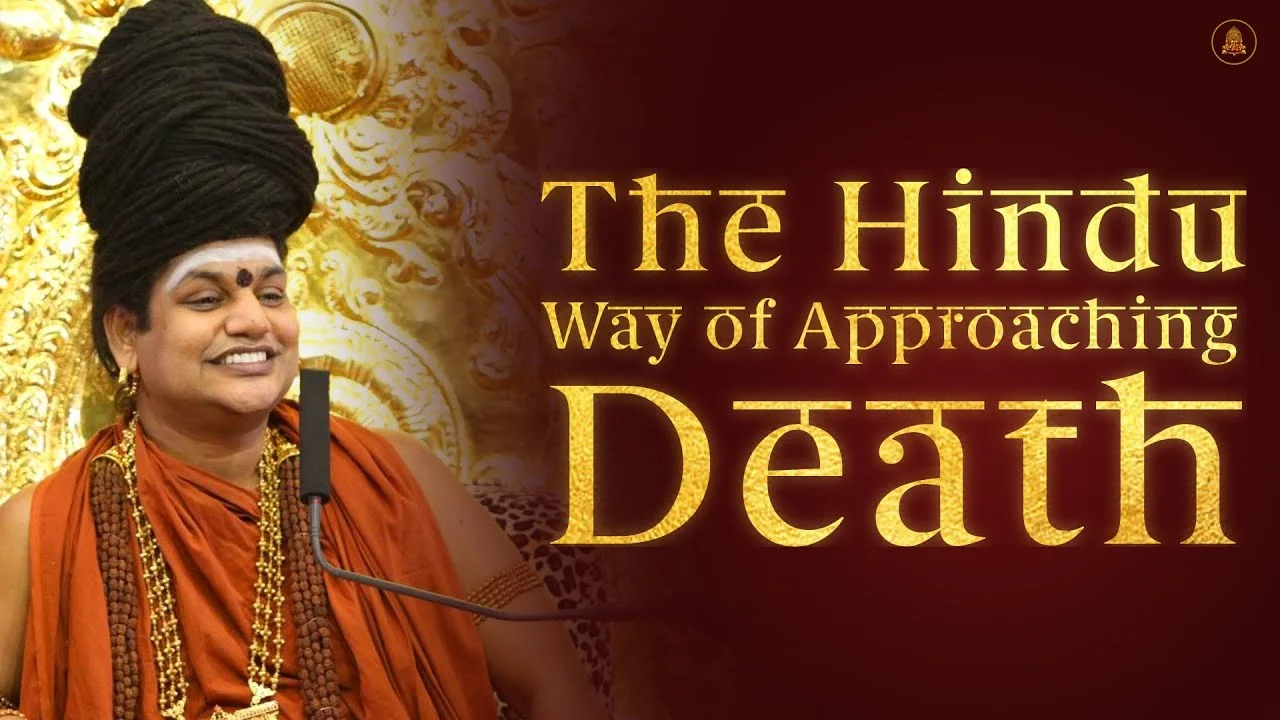
What happens after death, according to the Hindu way?
The SPH answers through a verse that asks for two things. It asks that your life energy, called prana, merge into the cosmic life energy. It asks that the body go back to its basic elements and be reduced to sacred ashes.
The SPH explains this through the seventeenth verse of an Upanishad. He calls it the Hindu way of approaching death. The verse is a prayer said at the time of leaving the body. It asks the life energy to relax and merge into the all-pervading cosmic life. It asks the body to retire to the elements.
The SPH says this one verse holds the whole picture. What you need to do before death. What happens during death. What life is after death. Even though there is a full Upanishad on death, this single verse gives the essence.
So the verse lets the breath merge and the body go back to the elements. But as the next sections show, there is something in you that is neither the breath nor the body.
Let the vital life energy wind present in the body now merge into the all pervading eternal cosmic life energy
Why do Hindus cremate the body after death?
Hindus cremate the body because, after death, it has no more use. The same verse that describes death also shows the need for cremation.
The SPH puts it very plainly. Once you leave the body, you do not need it. Let the prana merge with the cosmic prana. Let the body go back to its basic elements. There is no reason to hold on to it.
He adds something important. If you want, you will have one more body. You will take a new body. But this body is not required anymore.
This is why the verse speaks of the body being reduced to sacred ashes. The body took its shape for a time, and it can go back to the elements it came from. The SPH says the Upanishadic Rishis clearly knew these sacred truths about life and death, and they put them into this verse.
After you leave the body, it has no use. You don't need this after that. If you want, you will have one more body. You will take a new body but this itself is not required.
What part of you continues and matters after death?
There is something in you beyond your breath and your body. Only what that inner being did during life matters.
The verse first asks the breath to merge and the body to go back to the elements. Then it says, in effect: O Cosmos, please remember all I did to reach you. The SPH asks, what does this mean? It means there is something inside you beyond the life force and the body.
He calls it the individual consciousness. And here is the key point. The actions it performed are not what counts. What counts is the context it was holding. In other words, the inner space you lived from matters more than the list of things you did.
there is something beyond your breath your body, whatever that did during its existence stay inside the body, only that matters.
Do you need to repent for sins or count good deeds before you die?
No. The Upanishad does not ask you to remember your sins or your merits while you are dying.
The SPH is very clear here. The verse does not say, O body, remember all the charity you gave. It does not say, remember how good you were. You are not asked to repent for the bad things you did. You are not asked to make a confession. You are not even asked to do completion.
He also says a real Hindu priest will not stand next to a dying person and bargain with them. He will not say, give your property and your sins will be forgotten. In The SPH's words, a Hindu Guru can never do such negotiation. The interest is in the liberation of the person leaving the body, not their money.
The SPH calls this a big relief. Nobody is asking you to feel proud of your charity, as if it were a visa to heaven. Nobody is asking you to carry your sins to the last moment.
Nobody is asking you to remember all the sins you did and repent for it. Nobody is asking you to remember all the charity you did and feel proud about it
What should you remember at the moment of death?
Remember only what you did to achieve oneness with the Cosmos. That is all that is worth remembering in the last moment.
The verse works from both sides. You pray to the supreme consciousness: remember what all I did to become one with you. And you tell your own being: remember what all you did to become one with him. Both sides are asked to remember the same thing.
Why only this? The SPH explains that all your obstacles have already become useless. Money, bank balance, wealth, relationships, ego, body and mind. If any of these kept you from oneness, they no longer have any use.
He gives a simple picture. At that time, they won't even let you get into your own car. They will only put you in an ambulance. You cannot sign any checkbook. All the things that distracted you from the space of oneness are now useless.
So the only thing left to hold is the goal itself.
remembrance of the goal only is required during death because all obstacles have already become useless to you.
What happens to relationships and memories when death comes?
The SPH says that when death begins, the people and memories of your life become irrelevant. He says you will have neither completion nor incompletion with them.
He says even the closest relationship you think you have will look almost unknown. Who is this person? I don't remember him.
He gives an example. Ask someone living in the US: are you complete or incomplete with the people living on the planet Jupiter? They will say neither. Those people are simply irrelevant to them. In the same way, as the death pain starts and you begin moving, he says people, places and objects become irrelevant.
There is one exception. At the most, you may see the Guru's form. Not the outer way you related to him, but the inner way, as your own Atma Murti. That inner relationship becomes real at that moment.
The only memory worth holding is everything you did to experience oneness with the Cosmos.
when the death pain starts and you start moving, all the people with whom you lived will become irrelevant. The memories will become irrelevant.
Why should you let go of guilt and struggles at the end of life?
Because guilt and repenting only remind you of your struggles. At death, those struggles no longer have any power over you.
The SPH explains it this way. When problems are still there, it makes sense to think about your struggles. But at death, the problems have lost their power. Anything else you hold, like repenting or guilt, will only pull your mind back to the struggle. What you need now is to remember the goal.
He says that the moment the pain of death starts in your system, everything becomes useless. So what is the point of thinking about something that is no longer part of you?
The only thing you need to remember is the goal: oneness.
Now you don't need to remember the struggles, you need to remember about the goal.
Watch the full satsang
The Hindu Way of Approaching Death | Nithyananda Satsang | 25 Jan 2016
Topics
Read similar articles
How to Be Happy When Your Joy Depends on Other People
To be happy, bring your energy back to your own center instead of leaving it in other people's approval. When your joy no longer waits for others to smile at you, you become happy and you share that joy with others.
How to Meditate: Start With an Empty Cup
To meditate, come with an empty head, like an empty cup, and give the technique an honest trial without belief or doubt. Put yourself into it completely, drop your titles, and give it time instead of checking for results after every session.
What Is Dharma? Living in Tune With How the Cosmos Works
Dharma means knowing how the cosmos works and aligning your life to it. When your wealth and your pleasures are both centered on dharma, life flows naturally toward moksha, complete freedom.