
What is a mantra?
A mantra is a sound. Its value is in its vibration, not in any meaning the words carry.
Many people ask The SPH what their mantra means. His answer is very direct. A mantra cannot have meaning. If it has a meaning, it is not a mantra. Its only importance is phonetic: sound and vibration. It is not linguistic. No meaning is conveyed through it.
The SPH explains that almost all the branches of the Vedic tradition work with this method. Every branch gives a particular sound or mantra. Any master, any yogi, any rishi will give you some mantra. So even if you chant just one mantra, you are already working with this method, knowingly or unknowingly.
Mantra cannot have meaning. If it has got meaning, it is not mantra. Be very clear.
What does a mantra actually do?
A mantra helps you become the center of the sound. When you work on any mantra, you become the center of that sound, that vibration, that frequency.
The SPH says a mantra is used to make you realize that you are the center of the cosmic sound, the Anahata Dhvani. He says that by going into the mantra, you suddenly realize you are the center of the sound.
In his words, a mantra is used for a purpose. That purpose is raising your frequency, not giving any meaning. He teaches that all mantras and chantings lead to a different frequency and a different awareness.
Mantra is used for a purpose, purpose of raising your frequency to a different level, not for giving any meaning, conveying any meaning.
What is the difference between a mantra and an engram?
The difference is in what the word does once it is inside you.
The SPH gives a simple definition. An engram is a word that enters your inner space and creates more and more bondage. A mantra is a word that enters your inner space and liberates you.
This changes how we think about mantras. A mantra is not just a special word from a book. It is defined by its effect. A word that binds you is an engram. A word that frees you is a mantra.
So the real question is not only which words you hear. It is what you do with them once they come in.
Those words which goes into your inner space, creates bondage is engram. Words which enters your inner space and liberates you is mantra.
Can any sound become a mantra?
Yes. The SPH teaches that any sound can become a mantra, depending on how you receive it.
When a sound comes inside you, if you do not give meaning to it and just go to its center, it becomes a mantra. He uses a very human example. Even your spouse shouting at you can become a mantra.
The opposite is also true. If you give meaning to a word and move outward with it, even a mantra can become a samskara.
So there are two directions. You can travel with the sound to the center of the sound. Or you can give meaning to the sound and go outward. The SPH says clearly that this is your decision.
This is freeing. You do not have to wait for perfect conditions or perfect words. The sound around you right now can be used. What matters is whether you go toward its center or get caught in its meaning.
Any sound, when it comes inside you, if you don't give meaning to it and just go to the center, even your spouse shouting at you can become mantra.
How do you practice with a mantra or with sound?
This practice is simple, and you can do it almost anywhere. The SPH says you do not need a separate place to practice. You do not even need silence. Even in a marketplace, you can do it.
Here are the steps, drawn from his words:
- Take a sound. It can be a mantra you were given, or any sound that comes to you.
- Let the sound come inside you.
- Do not give meaning to it. Do not judge it or comment on it.
- Travel with the sound toward its center.
The SPH says that if you give meaning to a sound, you go outward. If you do not give meaning and just go to the center of the sound, it becomes a mantra.
No special setting is needed. Any place is okay.
You don't need a separate place to practice. Anywhere you can do, any place is okay, because you don't even need silence.
Can a mantra become a samskara?
Yes. Even a mantra can turn into bondage if you hold it the wrong way.
The SPH explains that people sometimes make a mantra into a samskara. This happens when you get conditioned by one particular mantra and start disliking people who use another one. You get attached to one sound and do not want to hear any other sound.
So the same tool works both ways. If you go outward, even a mantra can become a samskara. If you go inward, even a samskara can become a mantra.
The SPH says sound is a very powerful method. It can raise you to a higher frequency or drop you into a lower one. Which way it takes you is your choice.
So even mantra, if you go outward, can become samskara. Even samskara, if you go inward, can become mantra.
Why do everyday sounds affect us so much?
The SPH teaches that sounds can touch you even when you are not fully aware of the outer world.
He tells a story about a small village near Calcutta. Every night at two o'clock, a train passed through. One day the route changed and the train stopped coming. The whole village complained. They said they were hearing strange sounds and were disturbed. They had been waiting for that train sound every night. When it did not come, they started hearing all the small sounds around them, and that change disturbed them.
He says that if you have even a subtle resistance to sounds, you can get irritated again and again without knowing why. It becomes an unconscious habit. This is why he says never carry irritation against anybody or anything.
See, if you even have a subtle resistance to sounds, constantly you will be getting irritated without knowing why you are getting irritated.
What stops a sound from becoming a mantra?
What blocks it is the habit of judging and giving meaning to every sound.
The SPH describes thorns in your inner space. These thorns stop the sound from flowing through you. He says that whatever stops the flow of sound in your inner being is the root of suffering.
He teaches that if any sound or noise around you can just flow through you, without being judged and without being given any meaning, you will suddenly see you are liberated. But our conditioning is deep. To every sound, we respond, either positively or negatively. We do not want to miss a single word.
He gives an example everyone knows. Someone comes and says another person was talking about you. You know you will get upset if you hear it. Still, the temptation is strong, and you ask them to tell you. Then you start making your own meaning. What did he mean? Is he like that? Am I like that? With your own words and your own commentary, you are now ready for a big suffering.
The practice is the opposite. Let the sound pass. Do not add the commentary. Go to the center instead.
Any sound, any noise created around you, if it can just flow through you without getting judged, without being given any meaning, you will suddenly see you are liberated.
Watch the full satsang
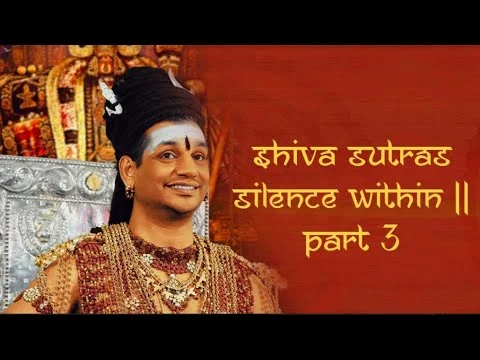
Silence Within (Part 3) | Shiva Sutras Satsang | May 25, 2007
Topics
Read similar articles
How to Be Happy When Your Joy Depends on Other People
To be happy, bring your energy back to your own center instead of leaving it in other people's approval. When your joy no longer waits for others to smile at you, you become happy and you share that joy with others.
How to Meditate: Start With an Empty Cup
To meditate, come with an empty head, like an empty cup, and give the technique an honest trial without belief or doubt. Put yourself into it completely, drop your titles, and give it time instead of checking for results after every session.
What Happens After Death? The Hindu Way of Approaching Death
The SPH explains death through one Upanishad verse. It prays that your life energy merge into the cosmic life energy and that the body go back to its basic elements. What matters is not your sins or good deeds, but only what you did to become one with the Cosmos.