
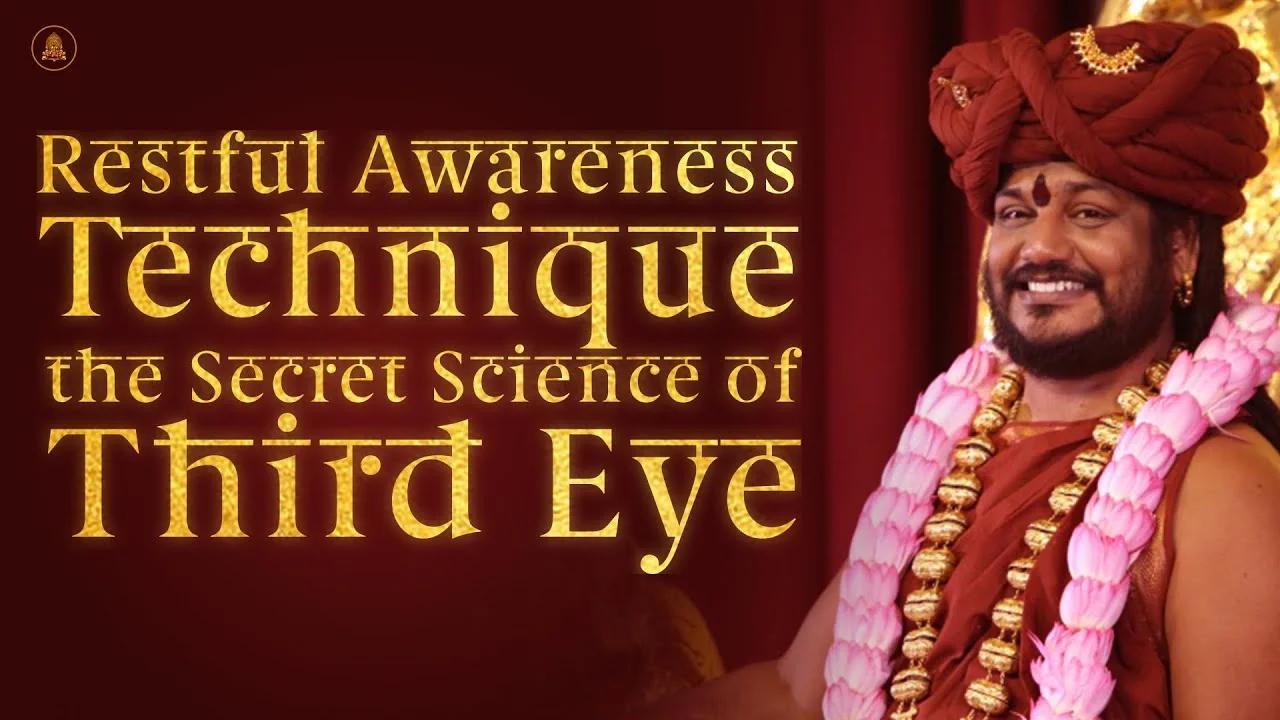
What is awareness, according to The SPH?
In this satsang, The SPH speaks about one kind of awareness: restful awareness. It is simple. It means remembering yourself without any tension or stress in the forehead.
Whenever you remember you, a little tension shows up in the forehead muscle. He says that only with this tension in the forehead muscle can you even remember you.
Restful awareness is the opposite of that. You remember you, and the forehead stays relaxed. No tightness. No strain. Just a light, easy remembrance of yourself.
The SPH puts it clearly: the moment you remember you, there should not be any tension in that region. That is what he calls restful awareness.
He also says it is not hard to reach. It can be brought just by simple declaration and practice. You decide, and you practice.
whenever you remember you, remember you, it is always a tension in the forehead, stress in the forehead.
What does restful awareness feel like?
The SPH gives a very clear picture. Restful awareness feels like a cool breeze. Inside the skull and outside the skull, there is a cool, fresh feeling.
He says it should be a cool breeze feeling, not hot clay. If you are having a hot clay feeling, that is what is inside the skull. Then consciously remember, and decide to have the cool breeze feeling.
So you can check yourself right now. Bring your attention to your forehead. Is there tension there? Is it hot clay, or a cool breeze?
He describes the right state in a few short words: no tension there, no stress there, pure restful awareness.
He calls this a physical, measurable scale. You do not need to guess. The forehead muscle tells you where you are.
no tension there, no stress there, pure restful awareness, a cool breeze feeling inside and outside.
Why does restful awareness matter?
The SPH calls restful awareness the vatavarana, which means the atmosphere. It is the atmosphere in which the third eye can flower and your will can grow.
He explains that will grows and expands in the space of restful awareness. Never in the space of chaos or tension.
This leads to two very different ways of making a decision. When you make a will and there is stress in the forehead, he calls it will arrogance. It is not going to be successful. When you make a will and there is restful awareness in that area, he calls it will persistence. That is the will that succeeds.
So restful awareness is not only a pleasant feeling. It is the ground your decisions grow from. A relaxed forehead lets you hold on to what you have decided. A tense forehead slowly pushes you to drop it.
The SPH calls this the basic condition for the third eye to flower and for will persistence to become reality.
Whenever you make a will, if there is a restful awareness in this area, that is will persistence, you are going to be successful.
Why do we give up on what we decide?
The SPH gives a direct reason. When you create a will and stress builds up in the forehead, there is a fight inside you.
And how long can you keep that stress? You can't. So naturally you give up on your will. The decision is not fulfilled. It turns into will failure, will arrogance and will pain.
He goes further. With stressful remembrance of you, you will not hold on to any will you generate. You give up inside, even if things seem to work out outside.
If something does succeed in that state, he says you are not really responsible for it. It is only an accident. Your success may be because somebody else failed, not because you succeeded. That kind of success may happen once or twice, not more than that.
But when success comes from you, from a relaxed and steady will, it can become a repeating thing in your life. For that, the first step is a stress-free remembrance of you.
If you succeed because somebody failed, it can be only accidental success. It may happen once or twice, not more than that.
How do you practice restful awareness?
The SPH gives a simple practice in this satsang. Here are the steps as he describes them.
- If you are at the Bangalore Aadheenam, pick up a banyan leaf that the tree has dropped by itself. He calls a fallen leaf a prasadam, a sacred gift. Do not pluck a leaf from the tree.
- If you are anywhere else, use the sacred ash, Vibhuti, from the temple or given by him. Apply it on your forehead.
- Lie down in your usual posture and support your head. Close your eyes. Put the leaf or the sacred ash on your third eye.
- Tell yourself: oh Sadashiva, let the atmosphere for the third eye to flower happen, which is restful awareness.
- Let the whole forehead muscle relax completely.
He says that when you do this, you will see restful awareness start happening. And if you fall asleep, that is okay. It will not be like a regular sleep. It will be the space of restful awareness.
If you are anywhere other than the Bangalore Aadheenam, put the sacred ash, lie down, support your head and tell yourself, oh Sadashiva,
How long should you practice restful awareness?
The SPH gives a clear time range for the lying-down practice. Do it for at least 21 minutes. Minimum 21 minutes, maximum 42 minutes.
If you go beyond 42 minutes, he says you have slipped. So he suggests keeping an alarm, or asking someone to wake you. He jokes that they can pour cold water on you.
The 21 minutes is a dedicated session. But the practice does not end there. He asks you to keep the forehead in restful awareness through the day, whatever you may be doing. In the satsang he asks for it to be practiced consciously for the next 48 hours, and at the end, at least for the next 24 hours.
Whether you are awake or asleep does not matter. The forehead area needs to stay relaxed.
He also says this is a primary practice, not a preliminary one. It is not a small first step you leave behind. It is a main part of the yoga, especially to awaken the third eye.
So whoever is going to practice with Basma or the Banyan leaf, you have to do at least 21 minutes. Minimum 21 minutes, maximum 42 minutes.
What blocks restful awareness?
The main block, as The SPH describes it, is becoming heavy about you and life.
Restful awareness means remembering the forehead region in a very relaxed way, a light way. When you take yourself and your life too heavily, the heat in that area increases. The cool breeze turns into hot clay.
This heavy, stressful remembrance of you leads only to will arrogance. Any will you make, you give up on inside.
The SPH says restful awareness can be brought just by simple declaration and practice. Consciously remember, and decide to have the cool breeze feeling.
The moment you remember you, there should not be any tension in that region.
Means remembering that region in a very relaxed way, light way, without being heavy about you and life.
Watch the full satsang
Restful Awareness Technique – the Secret Science of Third Eye | Satsang | September 2, 2016
Topics
Read similar articles
What Is Fear, and How Do You Go Beyond It?
The SPH teaches that fear lives in the unconscious, the dark corners of the mind that you have never looked at. He says your very nature is beyond fear, and he guides a meditation in his program to go through the layers of fear.
What Is Detachment, Really? Going Beyond Attachment and Detachment
True detachment, called vairagya, is not giving things up. The SPH teaches that vairagya means going beyond both attachment and detachment: a choiceless state where you neither run after wealth nor run away from it, and live with awareness.
How do you deal with anger without suppressing it?
Stop focusing on the person or the reason behind your anger, and turn toward the place inside you where the anger is rising. The SPH teaches you to handle anger as an energy, not as an emotion to fix, hide or swap for compassion.