
Who is Rāma, and which avatar of Vishnu is he?
Rāma, also called Ram or Sri Rama, is a major deity in Hinduism. Hindu tradition worships him as the seventh avatar of Vishnu. An avatar is a form God takes when he comes to earth.
Rama is the hero of the Ramayana, an ancient epic poem. Its main version was composed by the sage Valmiki. The story says Rama was born in Ayodhya, the capital of the kingdom of Kosala. His father was King Dasharatha, and his mother was Kausalya, the king's first wife.
Tradition calls Rama a Purnavatara, a complete avatar of Vishnu. Yet the stories also say this avatar was not meant to show Vishnu's divine powers. Rama lives as a human being, with human struggles and hard choices.
The Ramayana gives the reason. The demon-king Ravana had a boon from Brahma that protected him from almost everyone, even gods, but not from humans. So Vishnu promised to be born as a man, Rama, and end Ravana's threat.
Rama is especially important in Vaishnavism, the traditions centred on Vishnu. In traditions that focus on Rama himself, he is the Supreme Being. Some Hindus also see him as Para Brahman, the ultimate reality.
What does the name Rama mean, and what are his other names?
Rama is an old Sanskrit word found in the Vedas. It has two meanings, depending on the context. In one, it means dark or dark-coloured. In others, it means pleasing, delightful, charming or lovely. Its root, ram-, carries the sense of resting, standing still, rejoicing and being pleased.
Rama is known by many names:
- Ramachandra, meaning beautiful, lovely moon
- Dasarathi, meaning son of Dasharatha
- Raghava, meaning descendant of Raghu, of the solar dynasty
- Ram, a short form in wide use
- Ramar or Raman in Tamil, and Ramudu in Telugu
- Phra Ram in Thai and Lao, and Phreah Ream in Khmer
People often add the respectful title Sri or Shri, as in Sri Rama. In the Vishnu Sahasranama, the hymn of a thousand names of Vishnu, Rama is the 394th name.
Two other famous figures share the name. Parashurama is the sixth avatar of Vishnu. Balarama is the elder brother of Krishna. The Rama of the Ramayana is Ramachandra, the seventh avatar.
Some texts shaped by Advaita Vedanta use the name Rama for the Supreme Brahman itself. In that reading, Rama is the ever-blissful inner Self in whom yogis delight.
Why is Rama revered as an ideal king and model of dharma?
Hindus call Rama Maryada Purushottama. This means the ideal man, or the best of those who uphold dharma. Dharma is the right way of living, including one's duties. Tradition also calls him Vigrahavan Dharmah, dharma in living form. He is said to have had sixteen ideal qualities.
His choices in the Ramayana show why. Queen Kaikeyi, one of Dasharatha's wives, asked the king to keep an old promise. She demanded that Rama be sent to the forest for fourteen years. Rama accepted. He said his father must keep his word, and that he did not want power or pleasures.
In the forest, the texts say, he lived a simple life and protected sages who were being troubled. A devotee named Shabari offered him berries she had tasted first, to be sure they were sweet. Rama ate them all, seeing the love behind the gift.
After his return, Rama was crowned king in Ayodhya. His rule, called Rama Rajya, is remembered as just and fair.
Rama also taught balance. In the epic, he says virtue (dharma), desire (kama) and rightly earned wealth (artha) all matter equally. He adds that one should look within and never neglect one's true duties and rightful pleasures.
Scholars note that his story also raises hard moral questions. Different versions answer them in different ways, which keeps people thinking about it.
Who are Sita, Lakshmana, and Hanuman in relation to Rama?
These three are the closest figures in Rama's story.
- Sita is Rama's wife. She is the daughter of King Janaka of Mithila. Janaka promised her to the prince who could string a great bow of Shiva. Many princes failed. Rama took hold of it, strung it and broke it in two.
- Lakshmana is Rama's brother. When Rama left for the forest, Lakshmana went with him as a caring, protective brother.
- Hanuman is Rama's monkey companion. He was a minister of Sugriva, and he became one of Rama's most dedicated commanders.
Rama had two more brothers, Bharata and Shatrughna. Bharata's mother was Kaikeyi, whose demand sent Rama to the forest. Bharata himself was upset by it.
The story says Sita went with Rama into the forest. There, the demon-king Ravana carried her away to his kingdom of Lanka. Ravana pressed her to become his wife, and she refused him.
Rama and Lakshmana searched for her. They travelled south, met Sugriva, and gathered an army of monkeys, with Hanuman among its leaders. After a long war, Rama defeated Ravana and rescued Sita. They then returned to Ayodhya.
In the Ramayana and other major texts, Rama and Sita later had twin sons, named Kusha and Lava.
How is Rama shown in images and temples?
Rama's images share some features with other forms of Vishnu, but a few signs make him easy to recognise.
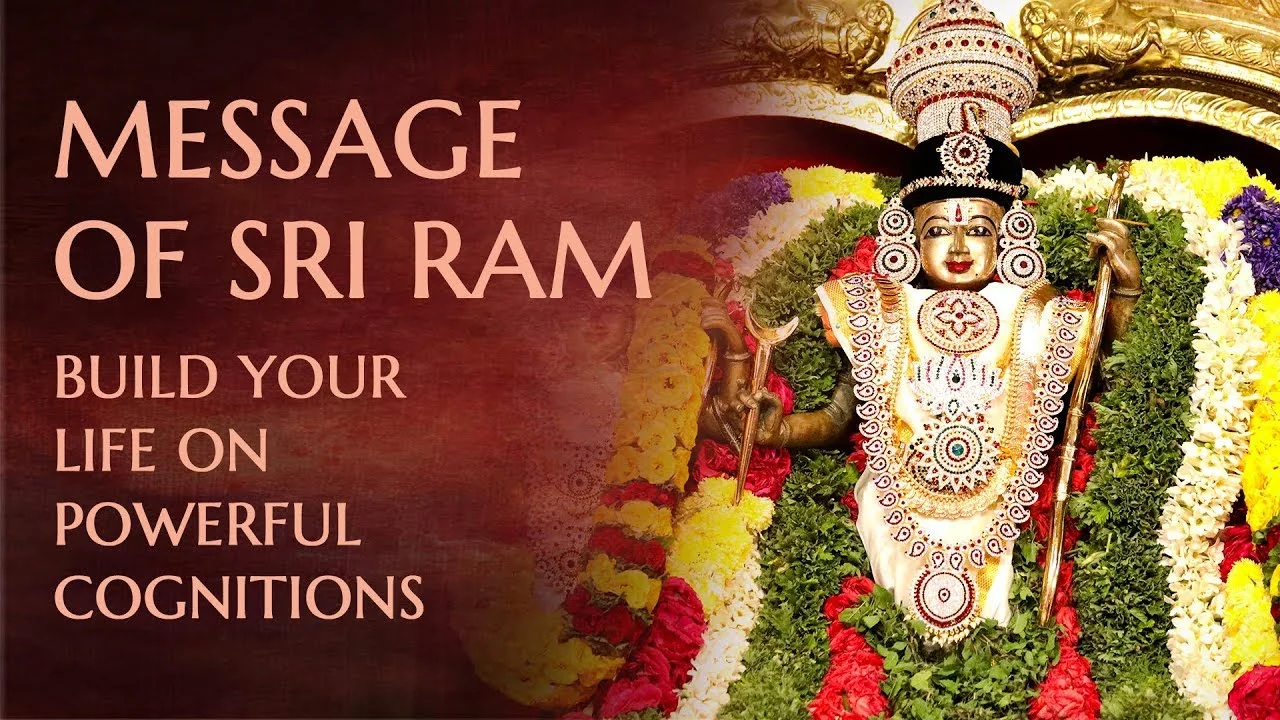
- He has two hands.
- He holds an arrow in his right hand and a bow in his left.
- His skin is shown dark, blue or black.
- He usually wears reddish clothes.
He is often shown with his family. Sita stands at his right side and Lakshmana at his left, both golden-yellow in colour. Hanuman stands nearby with folded arms. Sometimes his brothers Bharata and Shatrughna join the group.
The Ramayana describes Rama as charming and strongly built, with a dark complexion and very long arms. In one famous scene, Hanuman reaches Sita while she is held captive in Lanka. To prove he truly comes from Rama, he describes Rama to her. He speaks of broad shoulders, mighty arms, a deep voice like a kettledrum, and well-shaped limbs.
Statues show Rama in different standing poses. Some show him in tribhanga, a graceful pose with the body bent in three places, like an S. Many South Indian temples show him in dvibhanga, a pose bent in two places, still holding bow and arrow. Scholars disagree on which pose is most typical for Rama.
How do Hindus worship and celebrate Rama?
Rama's life is honoured through several festivals:
- Rama Navami celebrates his birth.
- Vijayadashami marks his victory in battle.
- Diwali is linked with his return to Ayodhya. Many believe people lit lamps, called diyas, to celebrate his homecoming. The festival is still marked with lights and fireworks.
Ramlila is another major tradition. It is a week-long festival of performance held in India every autumn. Groups stage Rama's story, based on the Ramcharitmanas of the poet-saint Tulsidas. UNESCO has listed this staging as part of the intangible cultural heritage of humanity.
Chanting Rama's name is a central practice. The Vishnu Sahasranama closes with a well-known verse. In it, Shiva tells his consort Parvati that he constantly delights in chanting Rama, Rama, Rama. Tradition holds that chanting this one name equals reciting all thousand names of Vishnu.
There is also a thirteen-syllable mantra called the Sri Rama Taraka Mantra. In Hindu theology, it is a strong prayer for spiritual liberation.
Many people also hear or recite the Ramayana itself. Many Hindus see Rama's life story as a picture of dharmic living.
Pilgrims visit places linked with his life. Chitrakoot, believed in Hindu tradition to be where Rama stayed early in his forest years, has many Rama temples. It is an important Vaishnava pilgrimage site.
What does The SPH teach about Rama?
In a satsang given on Rama's birthday, The SPH calls Rama Purushottama and says he is a symbol of everything best in the universe.
The SPH points out that four incarnations appeared on that day. Vishnu came as Rama, Adisesha as Lakshmana, and the Chakra and Shankha as Bharata and Shatrughna.
The SPH says Rama was targeted from the start of his life, yet he showed a rare kind of strength. In his teaching, the highest power is not using your powers even when attacked. Instead, you stay steady inside and let the law of karma do its work. He adds that Rama stayed steady in his inner space, and enjoyed the whole game of life.
The SPH also places Rama within the series of Vishnu's incarnations. He describes Rama as a complete, cultured ideal for a stable human civilization. He says Rama's was the most difficult incarnation. Rama had to show the grandeur of dharma while staying within the limits of a human frame. People need courage and confidence to practise dharma, and The SPH says Rama demonstrated the power of those values through tyaga, or sacrifice.
The SPH also describes Rama as a great devotee of Shiva, who chose to stay near Shiva temples so he could do his Shiva puja regularly.
highest powerfulness is not using your powers even while you are attacked and waiting for the law of karma to do its job
What is the message of Rama's life, according to The SPH?
The SPH sums up Rama's message in one line: build your whole life on powerful cognitions. Cognitions here means your deep understandings about life.
He points to the moment Rama lost his kingdom. The kingdom was taken away, but his kinghood was not. The SPH says Rama was king because of his powerful cognitions, not because of outer power. That is why, he says, Rama remains Raja Rama forever. His coronation, the Pattabhisheka, is still the most worshipped scene of his life.
The SPH also says the forest years should never be called exile. Rama's sandals sat on the throne of Ayodhya, so his home was never taken over. He calls those years the best part of Rama's life, a happy, devoted family life.
From this he draws a lesson for everyone. Everyone gets attacked, whether beggar or king. Being attacked does not make you unique. How you respond does. Most people build their name when they are powerful. The SPH says Rama built his when he lost everything.
His advice is simple. Whether a task feels easy, difficult or impossible, build powerful cognitions about life.
message of Srirama, build your whole life on powerful cognitions
Where should a beginner start learning about Rama?
Start with the Ramayana, the main source for Rama's life. Valmiki's Sanskrit epic is the primary text. But you do not have to begin there. Versions exist in most major Indian languages, and scholars speak of hundreds of tellings across India, Southeast Asia and beyond.
Some well-known versions:
- Ramcharitmanas by Tulsidas, in Awadhi, a language widely understood in northern India. It retells the story as loving devotion to a personal God.
- Ramavataram, also called Kamba Ramayanam, by the Tamil poet Kambar.
- Adhyatma Ramayana, a Sanskrit text that reads the story as a study of one's own soul. It presents Rama as Brahman, the ultimate reality.
For deeper study, there is the Yoga Vasistha. It is a long conversation between the young Prince Rama and the sage Vasistha. It moves from Rama's questions about suffering, to the desire for liberation, to the state of an enlightened and blissful Rama.
Keep in mind that the versions differ in many details. Scholars say no single version is the only correct one. Each is real and meaningful for its own region and tradition. The core stays the same: a struggle between good and evil, and a life guided by dharma.
Watch the full satsang
Message of Sri Ram Chandra - Build Your Life on Powerful Cognitions | Nithyananda Satsang | 25 Mar18
Topics
Read similar articles

Who Is Lord Krishna? A Guide to the Deity and Devotion
Lord Krishna is a major Hindu god, worshipped as the eighth avatar of Vishnu and, by many, as the Supreme God himself. He is loved for his compassion, love and playful spirit, and as the teacher who gave the Bhagavad Gita.
What Is Dharma? Living in Tune With How the Cosmos Works
Dharma means knowing how the cosmos works and aligning your life to it. When your wealth and your pleasures are both centered on dharma, life flows naturally toward moksha, complete freedom.
Who Is Ganesha? The Elephant-Headed Deity and What He Represents
Ganesh, also called Ganesha, Ganapati or Vinayaka, is the elephant-headed Hindu deity honored at the start of prayers, rites and new ventures. He is revered as the remover of obstacles and the lord of wisdom, learning and beginnings.