
Who is Ganesh?
Ganesh, also spelled Ganesha, is one of the best-known and most widely worshipped deities in Hinduism. He is easy to recognize. He has the head of an elephant, a large belly, and usually four arms.
In Hindu tradition, he is honored as the remover of obstacles and the bringer of good luck. He is also seen as the patron of arts and sciences, and as the lord of intellect and wisdom. Because he is the god of beginnings, people honor him at the start of rites and ceremonies.
Hindu texts describe him as the son of Shiva and Parvati. Yet he is not tied to one branch of Hinduism. He appears across its many traditions, and his images are found all over India, in temples, homes and village shrines.
The main texts devoted to him include the Ganesha Purana, the Mudgala Purana and the Ganapati Atharvashirsha. These and other texts tell many stories about his birth and his deeds.
What does the name Ganesha mean, and what are his other names?
The name Ganesha joins two Sanskrit words. Gana means a group or multitude, and isha means lord or master. So Ganesha means Lord of the Ganas. The ganas are often taken to be the troop of semi-divine beings who attend his father, Shiva. Some commentators read the name more widely, as Lord of Hosts, or lord of all created categories.
Ganapati is a close synonym. It joins gana with pati, which means ruler or lord. People often add the respectful title Shri before his name.
He has many other names, and each one points to something about him:
- Vinayaka: a common name found in the Puranas
- Vighneshvara or Vighnesha: Lord of Obstacles
- Ekadanta: the one with one tusk
- Lambodara: the one with a pot belly
- Gajanana: the one with an elephant face
- Buddhipriya: fond of intelligence
- Pillaiyar: his popular Tamil name, often explained as noble child
Outside India he has local names too. In Thailand he is widely known as Khanet, and among Sinhalese Buddhists in Sri Lanka he is called Gana deviyo.
Why is Ganesha invoked before starting something new?
In Hindu tradition, Ganesha is the god of beginnings and the Lord of Obstacles. That is the main reason people turn to him first.
He holds the title Pratham Pujya, the deity worshipped first, before any other. Hindus of all denominations call on him at the start of prayers, important tasks and religious ceremonies.
His role with obstacles works in two directions. He is popularly worshipped as the one who removes obstacles, both material and spiritual. But tradition also says he places obstacles in the path of those who need to be checked. The scholar Paul Courtright says creating and removing obstacles is his very purpose. So people seek his blessing before they begin anything new.
This shows up in daily life. People worship him before ventures such as buying a vehicle or starting a business. Writers invoke him as the patron of letters and learning. Dancers and musicians, especially in southern India, open performances such as Bharatanatyam with a prayer to him. Devotees believe that when Ganesha is pleased, he grants success, prosperity and protection in hard times.
Temples reflect the same idea. As the god of transitions, he often stands at the doorway of Hindu temples. This echoes his role in the stories as Parvati's doorkeeper.
How did Ganesha get his elephant head?
Hindu texts tell several versions. A few say he was born with an elephant head. But in most stories, he gets it later.
The best-known story goes like this. The goddess Parvati made Ganesha from clay to guard her. When Ganesha stood between Shiva and Parvati, Shiva cut off his head. Shiva then replaced it with the head of an elephant. The details of the fight, and where the new head came from, change from one telling to another.
Another story says Shiva created Ganesha from his own laughter. Shiva found the child too charming, so he gave him an elephant head and a large belly.
The texts also differ about his birth itself. In some, Parvati created him. In others, Shiva did, or both of them together. One version says he appeared mysteriously and Shiva and Parvati found him. Another says he was born from Malini, an elephant-headed goddess.
Ganesha's family includes his brother Kartikeya, the god of war, who is also called Skanda or Murugan. Regions disagree about who is older. In northern India, Skanda is usually called the elder brother. In the south, Ganesha is considered the firstborn.
What do Ganesha's elephant head and broken tusk symbolize?
Tradition links each part of Ganesha's form to an idea.
The elephant head is closely tied to Om, the sacred sound. Ganesha is called omkarasvarupa, which means Om is his form. The idea is that he embodies the first, primal sound. The Ganapati Atharvashirsha supports this link. It praises him as Om itself, and as all that exists. Some devotees even see the outline of his head and body in the written shape of Om, in the Devanagari and Tamil scripts.
The broken tusk is one of his oldest features. His earliest known name was Ekadanta, the One-Tusked. It refers to his single whole tusk, since the other one is broken. Some of the earliest images show him holding the broken piece in his hand. The Mudgala Purana gives the name Ekadanta to one of his incarnations, which shows how much this feature mattered.
His big belly is just as old. Two of his names, Lambodara and Mahodara, describe it. The Brahmanda Purana explains Lambodara in a striking way. It says all the universes of past, present and future are present inside him.
He is also closely linked with intelligence and learning. Many stories praise his cleverness and his love of knowledge.
What does Ganesha hold, and why does he ride a mouse?
In his standard four-armed form, Ganesha holds:
- an axe or a goad, a rod used to guide elephants, in one upper hand
- a noose, called pasha, in the other upper hand
- his own broken tusk in the lower right hand
- a sweet in the lower left hand, which he often tastes with his trunk
In a common modern form, the lower right hand does not hold the tusk. Instead, it faces the viewer in a gesture of protection or fearlessness, called abhaya mudra. A snake may appear around his neck or waist, and his forehead may carry a third eye or a mark of three lines.
He is often shown riding a mouse, or with a mouse near his feet. The mouse, named Mushaka, is his vehicle in many stories. People read it in different ways. Many see it as a symbol of desire and dullness that he keeps under control. The Sanskrit word for mouse comes from a root meaning to steal. A mouse that eats crops is itself an obstacle, so Ganesha riding it can show him as master of obstacles. Another view says that, like a mouse, Ganesha can reach even the most hidden places.
How do people worship Ganesha?
Worship of Ganesha is simple and very common. One writer notes that hardly any Hindu home in India is without an image of him.
Common parts of his worship include:
- chanting mantras such as Om Shri Ganeshaya Namah, a salutation to the illustrious Ganesha, and Om Gam Ganapataye Namah, a salutation to the Lord of Hosts
- offering sweets, especially modaka and small sweet balls called laddus
- using red sandalwood paste and red flowers, since he is linked with the color red
- offering durva grass
Ganesha Chaturthi is often celebrated for ten days. People bring in clay images of Ganesha, which stand for his visit. At the end, the images are immersed in water. Some families immerse them earlier, on the second, third, fifth or seventh day. The festival is celebrated across India and is most popular in Maharashtra.
Ganesha also has many temples of his own. The eight Ashtavinayak shrines near Pune, in Maharashtra, are especially well known.
What does The SPH teach about Ganesha's symbols?
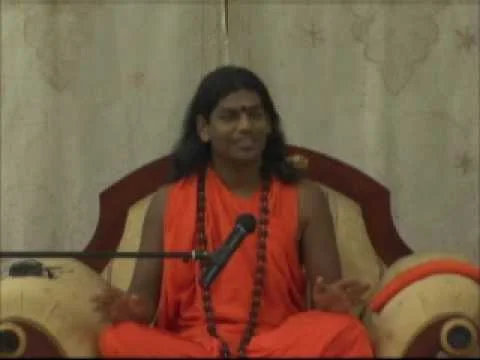
The SPH teaches that Ganesha's form itself carries a message. In a Ganesha Chaturthi satsang, he says that if you understand what Ganesha carries, you understand the truth Ganesha expresses.
According to The SPH, the goad, or ankusha, stands for the technique of unclutching. Even a huge elephant can be guided by a small rod. In the same way, he says, a simple technique can steady the mind. The noose, or pasha, stands for emotional balance, with every emotion under control.
The broken tusk, The SPH says, stands for spontaneity and dedication. He retells the story of Ganesha writing down the Mahabharata as the sage Vyasa dictated it. When the pen broke, Ganesha did not stop Vyasa or leave to find another pen. He broke off his own tusk and kept writing.
The sweet in his hand shows the result. When these qualities come together, The SPH says, life becomes sweet, like the modaka Ganesha holds. He adds that the big belly expresses prosperity and joy.
The SPH also calls Ganesha the lord of the Muladhara, the root chakra, and the energy of pure, undisturbed visualization. That, he says, is why Ganesha is the Lord of Beginnings.
Actually, if you know how to unclutch and how to keep your emotions under your control, the life is sweet.
Do you have to belong to a certain group to worship Ganesha?
No. In Hindu tradition, Ganesha is a non-sectarian deity. Hindus of all denominations worship him, whatever their other affiliations, and call on him at the start of prayers and ceremonies.
He is honored across many paths:
- In the Ganapatya tradition, he is worshipped as the Supreme Being.
- In wider Hindu worship, he is the deity honored first, before any other.
- Devotion to him also reaches Jains and Buddhists.
- His name Vinayaka appears in Buddhist Tantras as well as in the Puranas.
His worship spread beyond India long ago. Early images show him as a major deity in what is now Indonesia, Thailand, Cambodia and Vietnam. Among Sinhalese Buddhists in Sri Lanka, he is revered along with other deities. Today, Ganesha temples stand in Southeast Asia, Nepal and several western countries.
For a beginner, the usual starting points are simple. Many people chant a short mantra such as Om Gam Ganapataye Namah, offer a sweet or a flower, or remember him before starting a new task. These are among the most common ways devotees connect with him.
Watch the full satsang
Ganesha Chaturthi 2007
Topics
Read similar articles
Kartikeya (Muruga): Who He Is and Why Devotees Revere Him
Kartikeya god, also called Muruga, Skanda and Subrahmanya, is the Hindu god of war and the son of Shiva and Parvati. Devotees revere him as a youthful warrior who defeated the asuras with his spear, the vel, and as a wise teacher, especially loved by Tamils.
Rama: Who He Is and Why Hindu Tradition Reveres Him
Rāma is a major Hindu deity, worshipped as the seventh avatar of Vishnu and the hero of the epic Ramayana. Hindus revere him as Maryada Purushottama, the ideal man, because his life shows how to live by dharma even in hard times.

Who Is Lord Krishna? A Guide to the Deity and Devotion
Lord Krishna is a major Hindu god, worshipped as the eighth avatar of Vishnu and, by many, as the Supreme God himself. He is loved for his compassion, love and playful spirit, and as the teacher who gave the Bhagavad Gita.