
What is Ganesha Chaturthi?
Ganesha Chaturthi is a Hindu festival in honor of Ganesha, also called Ganapati. The name means "Festival of Ganesha on the Fourth Day." Many people spell it Ganesh Chaturthi.
During the festival, people install a murti of Ganesha. A murti is a sacred image of a deity. Families keep small ones in their homes. Communities set up larger ones on temporary stages called pandals, where whole neighborhoods gather.
For several days, people pray, chant hymns, sing and offer sweets. Some keep a vrata, a religious vow that can include fasting. Food offered in worship is shared with everyone as prasada, a blessed gift.
The festival ends with a big procession. The murti is carried through the streets with music and group chanting. Then it is placed in a river, lake or the sea.
The festival goes by other names too. These include Vinayaka Chavithi and Vinayagar Chaturthi. In Tamil Nadu it is also called Vinayaka Chaturthi or Pillayar Chaturthi. In Maharashtra it is known as Ganeshotsav, and in Kerala as Lambodhara Piranalu. In Goa, Konkani speakers call it Chavath, or Parab, which means an auspicious celebration.
Why is Ganesh Chaturthi celebrated?
The festival celebrates Ganesha in his best-known roles. In Hindu tradition he is the god of new beginnings and the remover of obstacles. He is also honored as the god of wisdom, intelligence, fortune and prosperity.
The festival also has a story behind it. According to tradition, it marks Ganesha's arrival in the south of India to meet his brother Karthikeya.
Many devotees see the festival as a visit. The belief is that Ganesha comes down to the earthly world on Ganesh Chaturthi. He stays as an honored guest for the days of worship. When the murti is immersed at the end, he is believed to return to his heavenly home.
No one knows exactly when or how the festival began. Public celebrations in Pune go back to the time of King Shivaji, who used the festival to bring people together. Later, the Peshwa rulers, who were devotees of Ganesha, held a public festival in Pune. In the late 1800s, Bal Gangadhar Tilak helped turn it into a large community event. Along with worship, it came to include poetry, plays, concerts and folk dances. That mix of devotion and community life is still part of the festival today.
How is Ganesh Chaturthi celebrated at home and in public?
At home, preparation starts early. Families buy puja items a few days ahead. Many book a clay murti from local artisans up to a month in advance. They bring it home the day before or on the festival day.
Families clean a small part of the house and decorate it with flowers. The murti is installed there with Ganesha mantras, puja and bhajans (devotional songs) at an auspicious time of day.
The main steps often look like this:
- A priest performs Prana Pratishtha, a rite that invites Ganesha into the murti like an honored guest.
- Next comes Shodashopachara, a worship in sixteen steps. Coconut, jaggery, modaks, durva grass and red hibiscus flowers are offered.
- Hymns are chanted, such as verses from the Rigveda, the Ganapati Atharvashirsa, the Upanishads and a Ganesha prayer from the Narada Purana.
- Ganesha is worshipped each morning and evening, and the worship ends with an aarti.
In Maharashtra, families sing the Marathi aarti "Sukhakarta Dukhaharta," written by the saint Samarth Ramdas.
Public celebrations are run by youth groups, neighborhood associations and groups of traders. Local people and businesses help pay for them. Pandals are richly decorated and lit. They host singing, theater, music, readings of sacred texts and service such as blood donation drives and gifts to the poor.
What is modak, and what foods are offered to Ganesha?
Modak is the main sweet of the festival. Tradition says it is Ganesha's favorite. It is a dumpling made of rice or wheat flour. The filling is grated coconut, jaggery, dried fruits and other ingredients. It is either steamed or fried.
The same sweet has many names across India. It is modak in Marathi and Konkani, modakam or kudumu in Telugu, modaka or kadubu in Kannada, kozhukattai or modagam in Tamil, and kozhakatta or modakkam in Malayalam.
Another popular sweet is karanji. It tastes much like modak but has a half-moon shape. In Goa it is called Nevri, and Goans link it closely with the Ganesha festival.
Other regions have their own offerings:
- In Andhra Pradesh and Telangana, people offer modak, laddu, steamed rice-flour balls called vundrallu, a spiced jaggery drink called panakam, soaked moong lentils and a rice-flour and jaggery dish.
- In parts of Karnataka, people make panchakajjaya, a mix of coconut, roasted gram, sugar, ghee and sesame.
- In Goa, a local version of idli called sanna is also popular.
Food offered to the deity is called naivedya. A plate of modak traditionally holds 21 pieces. After the worship, the offerings are shared with the community as prasada.
What is Ganesh visarjan, and why is the murti immersed?
Visarjan means immersion. It is also called nimajjanam. On the last day of the festival, devotees carry their Ganesha murtis through the streets in processions. Families and groups sing, chant and play music. The procession ends at a river, lake or the sea, where the murti is lowered into the water. In Mumbai alone, around 150,000 murtis are immersed each year.
This custom carries several meanings in Hindu tradition:
- Ganesha, who came to the earthly world for the festival, is believed to return to his heavenly home after the immersion.
- The festival as a whole is seen as a reminder of the cycle of birth, life and death.
- Many believe that as the murti leaves the house, it takes away the obstacles of that home, and these obstacles end with the immersion.
In recent years, many people have grown concerned about water pollution from murtis made with plaster of Paris and chemicals. Goa has banned the sale of plaster of Paris Ganesha murtis and encourages traditional clay ones. In Tamil Nadu, murtis are usually made of clay or papier-mache. Some are made of coconuts and other natural materials.
Some families now skip open water. They dissolve a clay murti in a barrel of water at home. After a few days, they spread the clay in the garden. Some cities also run eco-friendly public immersions.
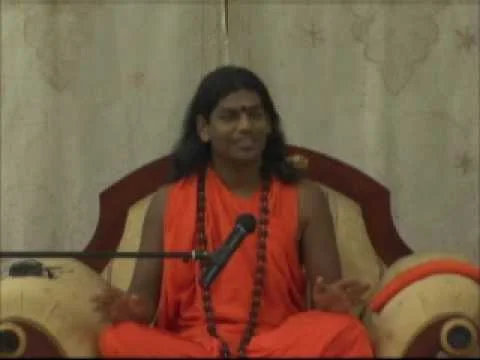
What does The SPH teach about Ganesha's form on Ganesha Chaturthi?
In a Ganesha Chaturthi satsang, The SPH said that if you understand Ganesha's form, you understand the truth it presents. He described Ganapati as a supreme expression of super consciousness. He then explained what each item in Ganesha's hands means.
- The ankusha, the small goad used to guide an elephant, stands for the technique of unclutching. The SPH pointed out that even a huge elephant can be guided by a small rod. In the same way, he said, a simple technique can guide the mind.
- The pasha, the rope, shows that all emotions are under Ganesha's control. It stands for being emotionally balanced.
- The broken tusk recalls a story. Ganesha was writing down the Mahabharata as the sage Vyasa spoke it. When his pen broke, he did not stop Vyasa or go to find another pen. He broke off his own tusk and kept writing. The SPH said the tusk stands for spontaneity and dedication.
- The sweet in his hand shows the result. When these qualities come together, The SPH said, life becomes sweet.
He also said the big belly expresses prosperity and joy, not obesity. For Ganapati, he said, the belly is seen as the cosmos, holding the whole universe. His invitation was simple: live like Ganapati by carrying these qualities.
Actually, if you know how to unclutch and how to keep your emotions under your control, the life is sweet.
Why does The SPH call Ganesha the Lord of Beginnings?
In the same satsang, The SPH said that on Ganesha Chaturthi, Ganapati appeared in the cosmic space. He linked the title Lord of Beginnings to a specific inner power.
The SPH described Ganapati as the lord of the Muladhara chakra, the root center at the base of the spine. He said Ganapati represents the pure energy of visualization. When this energy is disturbed, he explained, it becomes imagination. When it stays undisturbed, it is visualization.
New learning fits smoothly with what they began, because they act with spontaneity. This is why, he said, Ganapati is called Vigneshvara, the remover of obstacles.
The SPH also explained Ganesha's vehicle, the mouse. In his teaching, the mouse shows constant aliveness and intense activeness.
In that satsang, he then led a short meditation on Ganesha's form at the Muladhara chakra. He asked people to place their awareness there in a relaxed way, without concentrating hard. Afterwards he chanted Ganesha's names with the group and offered an aarti with 108 food offerings. He asked people to let Ganapati be the lord of all the beginnings in their lives.
Ganapati represents undisturbed visualization power. That is why we say Ganapati is the lord of beginnings.
Can you celebrate Ganesh Chaturthi outside India?
Yes. Ganesh Chaturthi is celebrated far beyond India. Hindu communities mark it in Sri Lanka, the United States, Canada, the United Kingdom, Australia, New Zealand, Singapore, Malaysia, Mauritius, Fiji, South Africa, the Caribbean and parts of Europe.
Some examples:
- The Philadelphia Ganesh Festival is one of the best-known celebrations in North America. There are also celebrations in the Toronto area.
- In the UK, a murti has been immersed in the River Thames in London, and yearly celebrations are held on the River Mersey in Liverpool.
- In Mauritius, the festival has a long history and is a public holiday.
- In Malaysia and Singapore, it is often called Vinayagar Chaturthi because of the large Tamil-speaking Hindu community there.
If you are new to the festival, a public pandal or temple celebration is an easy place to start. You can join the chanting and aarti and receive prasada with everyone else.
At home, you can follow the simple pattern families use. Clean a small corner and decorate it with flowers. Place a small clay murti there. Offer flowers, durva grass and a sweet such as modak in the morning and evening, and end with an aarti. When the celebration ends, you can dissolve the clay murti in a bucket or barrel of water and later spread the clay in a garden.
Watch the full satsang
Ganesha Chaturthi 2007
Topics
Read similar articles
Who Is Ganesha? The Elephant-Headed Deity and What He Represents
Ganesh, also called Ganesha, Ganapati or Vinayaka, is the elephant-headed Hindu deity honored at the start of prayers, rites and new ventures. He is revered as the remover of obstacles and the lord of wisdom, learning and beginnings.
Lord Maha Vishnu: His Role Among the Hindu Gods
Lord Maha Vishnu is one of the main gods of Hinduism, known as the Preserver who protects the order of the universe. In Vaishnavism he is the Supreme Being, and tradition says he comes to earth as avatars such as Rama and Krishna whenever evil threatens the world.
Rama: Who He Is and Why Hindu Tradition Reveres Him
Rāma is a major Hindu deity, worshipped as the seventh avatar of Vishnu and the hero of the epic Ramayana. Hindus revere him as Maryada Purushottama, the ideal man, because his life shows how to live by dharma even in hard times.